Jeddah Astronomy Society: The spring equinox is the best time to observe the aurora borealis

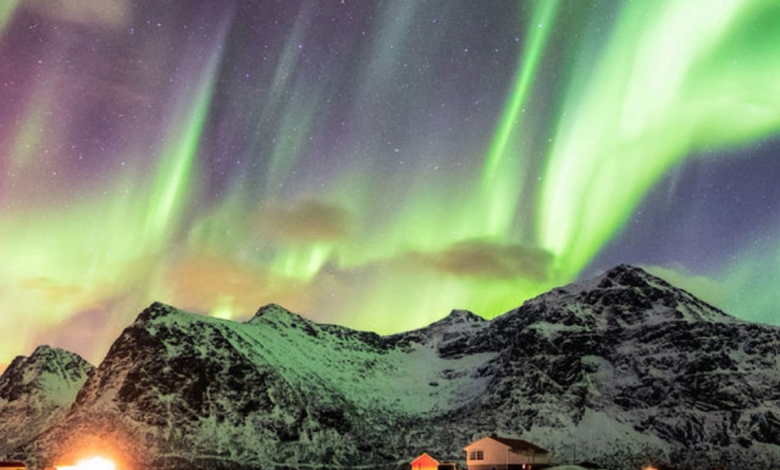
The Jeddah Astronomical Society, through its president, Engineer Majid Abu Zahra, revealed precise scientific details regarding the best times of the year to observe the enchanting phenomenon of the Northern Lights, confirming that the weeks surrounding the spring and autumn equinoxes represent the peak of opportunities to view these celestial displays, thanks to complex physical interactions between the sun and the earth.
The Russell-McPherson effect and magnetic cracks
Engineer Abu Zahra explained that the secret behind the increased activity of the aurora borealis during these periods is due to a physical phenomenon known as the Russell-McPherron effect. This phenomenon is directly related to the tilt of the Earth's axis relative to the sun during the equinoxes, which creates ideal conditions for the formation of what resemble "cracks" or openings in the Earth's magnetosphere.
These openings allow charged solar winds to flow more efficiently and at greater speed towards Earth's atmosphere, intensifying geomagnetic activity and igniting colorful light displays in the sky, especially over areas near the North and South Poles.
Historical statistics and the solar activity cycle
Based on historical data and studies spanning over 75 years of monitoring geomagnetic activity, the association indicated that March tops the list of the most active months for this phenomenon, followed closely by September, coinciding with the autumnal equinox. This information is particularly important now, as the sun is currently undergoing its 25th solar cycle, which is characterized by increased solar activity, sunspots, and coronal mass ejections, making the upcoming equinox seasons a golden opportunity for astronomy enthusiasts and those who chase geomagnetic storms.
The physics of colors and the magic of nature
In explaining the stunning colors of the aurora, the head of the Jeddah Astronomical Society pointed out that the phenomenon results from the collision of charged particles (plasma) from the sun with gas atoms in the upper layers of the atmosphere. The colors vary depending on the type of gas and the altitude; oxygen produces green and red colors, while nitrogen produces colors that tend toward blue and violet.
Despite the enormous energy carried by these particles, the Earth’s atmosphere and magnetic field provide a protective shield that safeguards life on the surface, so the impact of these storms remains limited to providing visually stunning displays that dazzle onlookers and stimulate the astrotourism sector in countries within the range of the high-flying displays.
Evidence of the Earth's sphericity
Abu Zahra concluded his remarks by pointing to another philosophical and scientific dimension of the phenomenon: the aurora borealis is a tangible, natural proof of the Earth's spherical shape. The circular distribution of auroral lights around the magnetic poles reflects the shape of the magnetic field that envelops the planet in a near-spherical form, thus embodying the continuous dynamic interaction between our planet and our parent star.