Jeddah Astronomy Society observes a giant sunspot and its impact on Earth

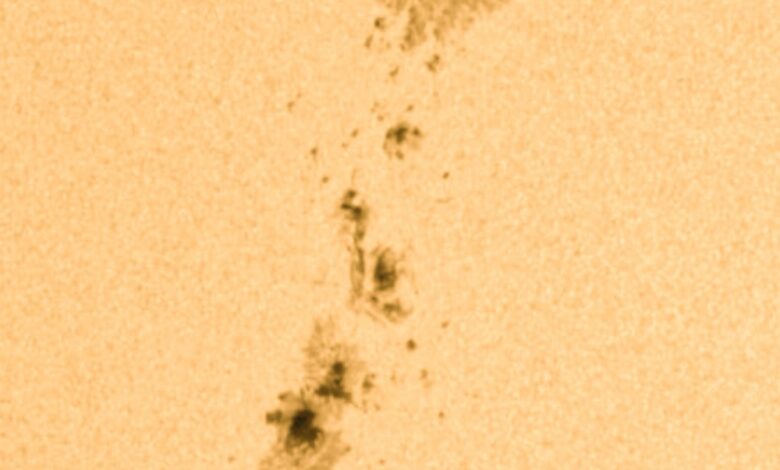
The Jeddah Astronomical Society announced significant astronomical developments related to solar activity, noting the continued observation of the giant sunspot AR4366 , described as one of the most active and complex magnetic regions during the current 25th solar cycle. This astronomical event has prompted scientists and observatories worldwide to raise their alert levels and closely monitor the situation, given the potential impact of this activity on Earth's space environment.
Details of the giant spot and its complex structure
Engineer Majed Abu Zahra, head of the Jeddah Astronomical Society, explained that sunspot AR4366 is not just an ordinary spot, but rather a rare phenomenon that scientists describe as an "archipelago of magnetic islands." This spot is characterized by a massive center more than twice the diameter of Earth, surrounded by dozens of scattered secondary spots, reflecting a highly complex and unstable magnetic structure, which makes it a potential source of powerful solar flares.
Unprecedented solar activity in cycle 25
This phenomenon occurs within the context of the 25th solar cycle, which has shown activity exceeding scientists' initial predictions. Since the beginning of February 2026, this active region has recorded dozens of solar flares, the most notable being a powerful X8.1 , which ranks among the strongest solar events recorded this year. X-class flares are the most energetic in the solar flare classification, releasing enormous amounts of energy equivalent to millions of hydrogen bombs simultaneously.
Expected impacts: between technology and human safety
Technically, experts warned that powerful flares could cause temporary disruptions to high-frequency (HF) radio communications, particularly in areas facing the sun at the time of the eruption. Increased solar activity could also affect the accuracy of GPS navigation systems and cause limited interference with some satellites in low Earth orbit.
Regarding the possibility of geomagnetic storms, Abu Zahra pointed out that the current position of the spot facing Earth increases the chances of coronal mass ejections (CMEs) being launched towards our planet. If these emissions reach Earth and interact with its magnetic field, we may witness geomagnetic storms ranging from mild to strong, potentially leading to the appearance of auroras at lower latitudes than usual.
A message of scientific reassurance
Despite the magnitude of the event, the Jeddah Astronomical Society confirmed that this activity poses no direct threat to human life or living organisms on Earth. The Earth's atmosphere and magnetic field act as a robust natural shield, deflecting most of the radiation and charged particles emanating from the Sun. These events remain of significant scientific value to researchers seeking to understand the dynamics of the parent star and the impact of space weather on the modern technologies we rely on daily.