Jeddah Astronomy: The retrograde motion of Uranus has ended and the planet has begun to disappear

The Jeddah Astronomical Society announced an important astronomical event awaited by astronomy enthusiasts, as the planet Uranus reaches the end of its retrograde motion today, Wednesday, February 4, 2026, to begin its journey back to its normal apparent motion towards the east among the stars, after months in which the planet appeared to move towards the west.
Optical illusion and scientific fact
In explaining the details of this event, Engineer Majid Abu Zahra, head of the Jeddah Astronomical Society, clarified that what observers perceive as a retrograde motion is not an actual change in the planet's orbit, but rather a purely optical phenomenon. This optical illusion results from the difference in orbital speeds between the planets of the solar system; Earth revolves around the sun at a much faster speed than outer planets like Uranus. When Earth passes this planet in its orbit, it appears to an observer on Earth as if the planet is moving backward for a specific period of time, even though it continues its usual orbit around the sun at a steady pace.
Uranus's journey from opposition to absence
This apparent retrograde motion began on September 6, 2025, and continued until early February 2026. This is a cyclical and natural phenomenon that occurs for all outer planets after they reach opposition. Uranus reached opposition with the Sun on November 21, 2025, the golden period for astronomical observation, when the planet was at its closest point to Earth, making it appear at its brightest and remaining visible throughout the night. With this retrograde motion now complete, the ideal viewing window is gradually closing.
The Ice Giant Planet and the Importance of Observation
Uranus, the seventh planet from the Sun, is one of the ice giants of our solar system. Due to its vast distance, it appears faint to the naked eye and only reveals its details through telescopes. Tracking its movements is particularly important for understanding the dynamics of the solar system and accurately calculating orbits. Over the coming weeks, the planet will begin its apparent approach to the Sun, reaching its highest point in the sky about four minutes earlier each night, meaning its visibility will gradually decrease until it disappears completely in the evening twilight.
Event monitoring and documentation techniques
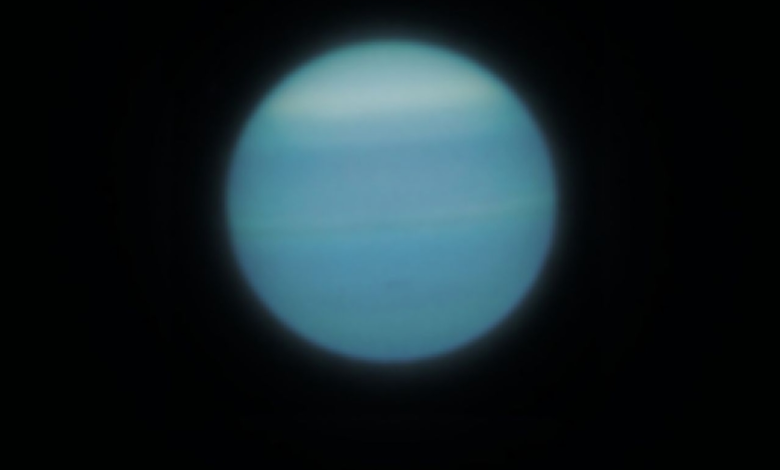
In the context of scientific documentation, the association noted that the images of the planet, revealing its intricate details, were captured using advanced equipment including the Celestron C14 Edge telescope and the ASI 224MC camera with specialized filters. These images were then processed software to compare them with reference data from the Hubble Space Telescope, underscoring the significant role played by amateur astronomers and astronomical societies in enriching scientific content and promoting a culture of astronomical observation in the Arab world.