
With the dawn of the third day of the blessed month of Ramadan, which coincides with a blessed Friday, those fasting throughout the Kingdom of Saudi Arabia are keen to accurately determine prayer times, specifically the times for Imsak (the start of the fast) (Fajr prayer) and Iftar (the breaking of the fast) (Maghrib prayer). These times are of paramount importance to ensure the validity of the fast and adherence to the Sunnah of the Prophet Muhammad (peace be upon him) in hastening the breaking of the fast and delaying the pre-dawn meal (Suhoor).
Cities across the Kingdom experience varying times due to its vast geographical area, with Iftar (the breaking of the fast) occurring earlier in the Eastern Province compared to the western regions. In this context, the National Center for Meteorology and other relevant authorities announced the precise times for Friday, the 3rd of Ramadan, to ensure ease of religious observance for citizens, residents, and pilgrims to the Two Holy Mosques.
Imsak and Iftar times for Friday, the 3rd of Ramadan
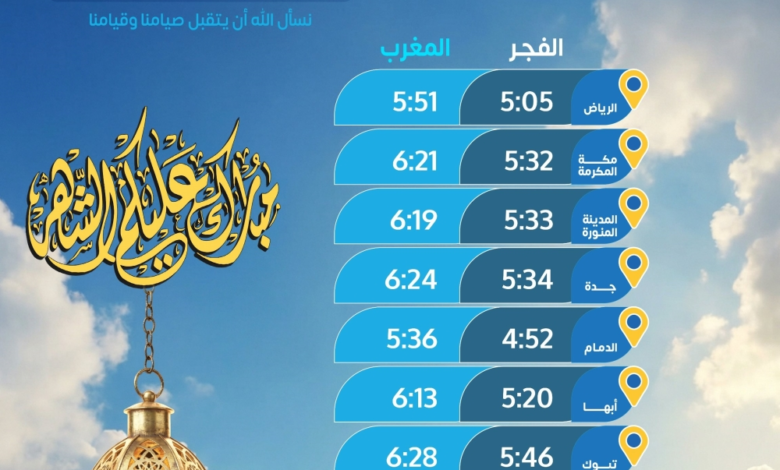
The following is a detailed list of Fajr (Imsak) and Maghrib (Iftar) prayer times in the major cities and governorates of the Kingdom:
- Dammam: Fajr 4:52 AM - Maghrib 5:36 PM.
- Riyadh (the capital): Fajr 5:05 AM – Maghrib 5:51 PM.
- Mecca: Fajr 5:32 AM - Maghrib 6:21 PM.
- Medina: Fajr 5:33 AM - Maghrib 6:19 PM.
- Jeddah: Fajr 5:34 AM - Maghrib 6:24 PM.
- Abha: Fajr 5:20 am - Maghrib 6:13 pm.
- Tabuk: Fajr 5:46 AM - Maghrib 6:28 PM.
- Buraidah: Fajr 5:16 AM - Maghrib 6:01 PM.
- Hail: Fajr 5:26 AM - Maghrib 6:08 PM.
- Al-Baha: Fajr 5:24 AM - Maghrib 6:16 PM.
- Arar: Dawn 5:29 AM – Sunset 6:08 PM.
- Sakaka: Fajr 5:32 AM – Maghrib 6:12 PM.
- Jazan: Fajr 5:19 AM - Maghrib 6:14 PM.
- Najran: Fajr 5:13 AM - Maghrib 6:07 PM.
Spiritual atmosphere and preparations by relevant authorities
The third day of Ramadan this year falls on a Friday, adding to its spiritual significance, as mosques are filled with worshippers from the early morning hours until the Taraweeh prayers. Knowing the precise timing is essential for balancing worship, rest, and work.
In a related context, the National Center for Meteorology announced that it has raised its readiness to the maximum level for the holy month of Ramadan, in order to monitor the atmosphere and provide accurate reports that help those fasting and pilgrims to know the weather conditions, which contributes to performing the rituals with ease and convenience, especially in Makkah and Madinah, which witness a high density of visitors.
Experts and specialists advise those fasting to adhere to eating the pre-dawn meal (suhoor) at its preferred time, well before the Fajr prayer, while ensuring they drink sufficient amounts of water, and to start breaking the fast with dates and water, following the Sunnah of the Prophet, and to prepare the stomach to receive food after long hours of fasting.