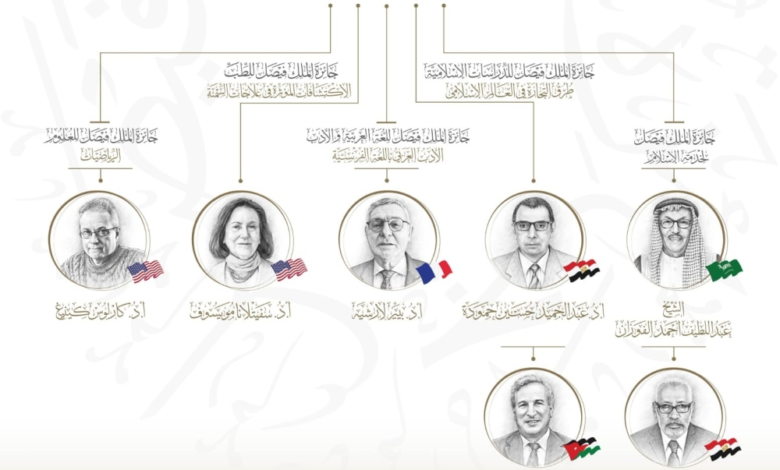

In a cultural and scientific evening held in the Saudi capital, Riyadh, the General Secretariat of the King Faisal Prize, in the presence of His Royal Highness Prince Turki bin Faisal, Chairman of the Board of Directors of the King Faisal Center for Research and Islamic Studies, announced the names of the winners of the prize for the year 2026. This announcement came as the culmination of a long process of examining and scrutinizing the nominated works, reflecting the prize’s continued commitment to appreciating human efforts that serve Islam and humanity.
The award's global prestige and importance
The King Faisal Prize is one of the world's most prestigious awards, recognizing scholars and thinkers who have made outstanding contributions to the fields of Islam, Islamic studies, Arabic language, medicine, and science. Since its inception, the prize has served as a platform for honoring pioneers, with many of its recipients later going on to win Nobel Prizes, underscoring the rigor of its standards and the integrity of its judging panels. This year's announcement reaffirms this commitment to highlighting impactful scientific discoveries and exceptional philanthropic initiatives.
Winners in Service to Islam and Islamic Studies
In the Service to Islam , the committee decided to jointly award the prize to Sheikh Abdul Latif bin Ahmed Al-Fawzan and Dr. Muhammad Muhammad Abu Musa. Sheikh Al-Fawzan earned the award for his distinguished approach to institutional charitable work and his establishment of the “Ajwad Endowment,” while Dr. Abu Musa received it in recognition of his scholarly contributions to Qur’anic rhetoric and his membership in the Council of Senior Scholars at Al-Azhar.
In the field of Islamic Studies , specifically on the topic of “Trade Routes in the Islamic World,” the award was jointly won by Dr. Abdul Hamid Hussein Hammouda from Egypt and Dr. Muhammad Wahib Hussein from Jordan. Their work was distinguished by its combination of historical documentation and archaeological field surveys using modern technologies such as GPS, thus offering a new perspective on ancient trade routes and their cultural impact.
Awards in Arabic Language, Medicine and Science
In the Arabic Language and Literature , which was dedicated to the topic of “Arabic Literature in French”, Professor Pierre Larcher from France won, in recognition of his efforts in translating the Mu'allaqat and pre-Islamic poetry, and presenting Arabic literature to the Francophone public with a sound critical vision.
In the field of medicine , the award kept pace with the growing global interest in obesity treatments, as it was awarded to Professor Svetlana Moiseyova from the United States, for her pioneering discovery of the peptide (GLP-1), a discovery that paved the way for the development of revolutionary treatments for diabetes and obesity that are now widely used globally.
The list concluded with the Science in Mathematics, which went to Professor Carlos Koenig for his contributions to nonlinear partial differential equations, which have opened up practical applications in the fields of medical imaging and fluid mechanics.