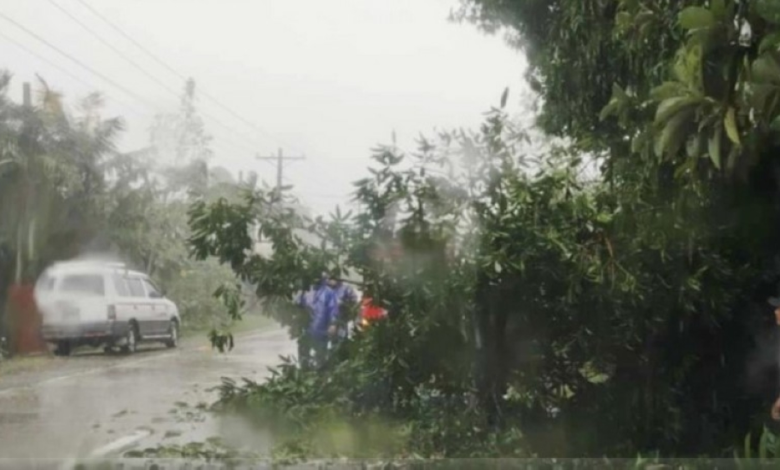

Two people were killed on Sunday in a tragic landslide triggered by Tropical Storm Ada, which swept across large areas of southeastern Philippines, leaving behind widespread damage and loss of life. This incident once again highlights the significant climate challenges facing the archipelago nation.
Details of losses and material damages
The Philippine National Disaster Risk Reduction and Management Council (NDRRMC) reported in an official statement that two people died as a result of a landslide that struck parts of the Bicol region on Luzon Island in the southeastern part of the country. The council explained that the effects of Typhoon Ada extended beyond this area, impacting approximately 7,170 families in the Bicol and Caraja regions.
As part of the rapid response to the disaster, 82 people were evacuated as a precautionary measure to ensure their safety, while authorities recorded massive floods that inundated 71 different areas, disrupting transportation and damaging local infrastructure as a result of continuous and heavy rains.
The geographical and climatic context of the Philippines
The Philippines is one of the most disaster-prone countries in the world due to its unique geographical location. The archipelago of over 7,600 islands lies along the Pacific Ring of Fire, a region known for its intense volcanic and seismic activity. Furthermore, the Philippines is situated in the path of the tropical cyclone belt, making it vulnerable to an average of 20 storms and typhoons annually, ranging from moderate to devastating.
This geographical nature, which combines rugged mountainous areas and extensive coastlines, makes landslides and floods frequent phenomena, especially during the monsoon season, which usually intensifies in the second half of the year.
Economic and social impacts
These disasters are casting a heavy shadow on the local and regional economy in the Philippines. Affected areas like Bicol rely heavily on agriculture and fishing, and storms and floods are damaging crops and destroying fishing boats, threatening food security and livelihoods for thousands of families.
Internationally, the recurrence of these phenomena in Southeast Asia is seen as living proof of the consequences of global climate change, with experts warning that rising ocean temperatures are contributing to an increase in the intensity of tropical storms, putting increasing pressure on governments to strengthen disaster risk reduction strategies and develop more resilient and robust infrastructure.