Jeddah Astronomy Society: Observing the last quarter of the moon and details of its topography

The phenomenon of the last quarter moon in the skies of the Kingdom
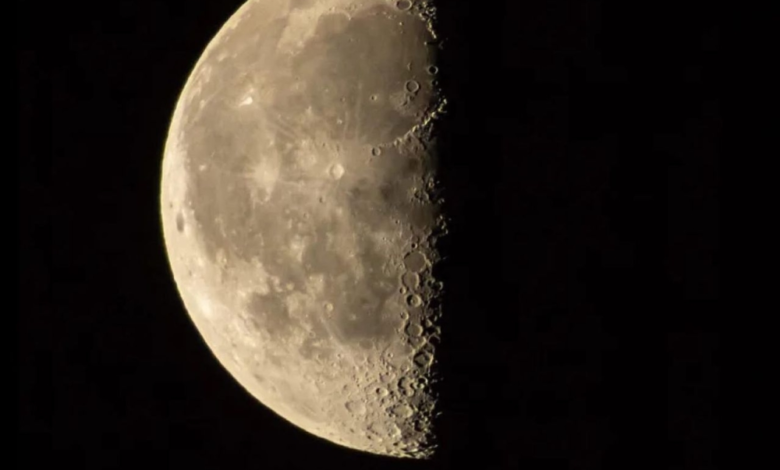
The Jeddah Astronomical Society, through its president, Engineer Majid Abu Zahra, announced a remarkable astronomical phenomenon anticipated in the skies of Saudi Arabia and the Arab region: the moon will reach its last quarter phase during the holy month of Ramadan. This phenomenon will occur after midnight on Tuesday, March 10, 2026. At this stage, the moon will appear with approximately half its disk illuminated, while the other half will be shrouded in darkness, representing the completion of about three-quarters of its orbit around the Earth during the current lunar month.
Lunar terrain clearly observed
The last quarter phase of the Moon is one of the best and most ideal times for amateur and professional astronomers to observe the lunar surface. Using binoculars or small telescopes, observers can see towering mountains and deep craters with remarkable clarity. This clarity is concentrated along the terminator, the line separating the illuminated and dark sides of the Moon. This exceptional clarity is due to the interplay of light and shadow along this line, giving the scene a three-dimensional appearance that makes astrophotography an unforgettable visual and scientific experience for those who love celestial phenomena.
The historical context of the importance of the phases of the moon
Historically, the phases of the moon have played a crucial role in human life, with ancient civilizations relying on them to determine agricultural seasons and navigate the seas. In the Islamic and Arab context, observing the moon is of paramount importance, as it forms the basis of the Islamic calendar (Hijri calendar) and determines the beginnings and ends of the sacred months and religious seasons. Early Muslim astronomers meticulously studied the moon's movements and phases, laying the foundations for modern astronomy. Today, astronomical societies, such as the Jeddah Astronomical Society, continue to revive this scientific legacy by encouraging the public to observe these phenomena with both passion and knowledge.
The moon's path and its gradual rise
Engineer Abu Zahra noted that after midnight, the moon will continue its gradual ascent in the sky. With the sunrise on Wednesday, March 11, 2026, the moon will reach a high position, appearing clearly against the backdrop of the sky illuminated by the enchanting blue light of dawn. During this morning phase, the moon can be easily observed using binoculars before it completes its journey and sets around noon local time.
The importance and expected impact of the phenomenon
Observing the last quarter moon is of great importance at the local, regional, and international levels. Locally and regionally, this phase is a vital indicator of the approaching end of the holy month of Ramadan, paving the way for preparations to celebrate Eid al-Fitr. Internationally and scientifically, this phenomenon provides a valuable educational opportunity for schools and universities to understand the mechanics of celestial bodies and the cycle of the moon's phases. Through direct observation, students and those interested can grasp the moon's movement around the Earth and how the angle of sunlight affects the appearance of its different phases.
Preparing to welcome the month of Shawwal
The head of the Jeddah Astronomical Society pointed out that over the next few days, the angle between the moon and the sun will gradually decrease. This decrease will lead the moon to enter the waning crescent phase, where it will be visible briefly before sunrise, in preparation for reaching conjunction. This conjunction marks the beginning of a new lunar cycle and the birth of the crescent moon of Shawwal for the year 1447 AH, thus completing a precise and continuous astronomical cycle.