During the holy month of Ramadan, Medina is imbued with a unique spiritual atmosphere, as official and community efforts combine to revive a deeply rooted cultural and religious tradition: providing food and honoring those who are fasting. In this spirit, the Ramadan iftar tables in the neighborhoods of Medina have transformed into a comprehensive community system that transcends simply offering a meal, becoming a platform for strengthening bonds among residents.
Ramadan Iftar Project: Numbers and Implications
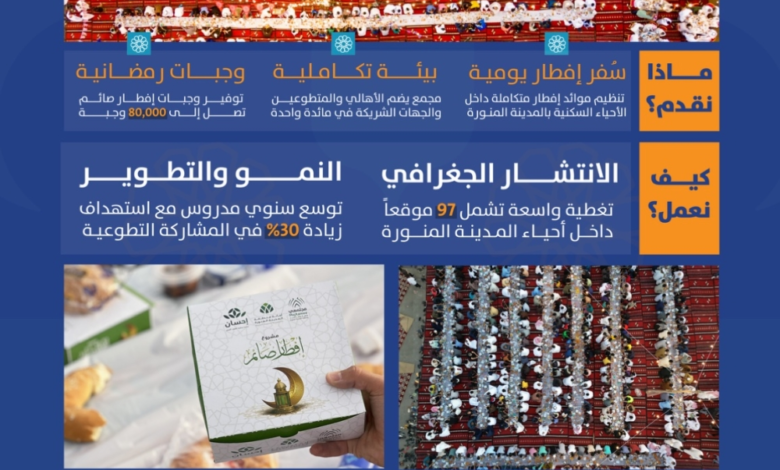
In a move reflecting its high level of organization and institutional work, the "Mujtama'i" Neighborhood Centers Association in Madinah, in strategic partnership with the Madinah Municipality, launched its Ramadan Iftar project, covering a wide geographical area encompassing 97 locations within residential neighborhoods. This well-planned expansion aims to reach the largest possible segment of beneficiaries, alleviate pressure on central areas, and strengthen the spirit of community.
Official statistics from the initiative indicate its massive scale, with over 80,000 Ramadan iftar and suhoor meals being provided, benefiting more than 40,000 fasting individuals. The initiative extends beyond mere distribution, encompassing the organization of communal iftar meals that bring together locals, residents, and visitors in a scene that embodies the highest ideals of Islamic brotherhood.
Historical heritage and values of urban hospitality
The phenomenon of communal iftars in Medina is not a recent development, but rather an extension of a great historical legacy known to the people of Medina since the time of the Prophet, embodied in the traditions of "Rifada" (providing food and water) and "Siqaya" (providing water). The Medinan community has always been known for its eagerness to honor the guests of God and visitors to the Prophet's Mosque. These modern initiatives aim to organize this innate generosity and place it within institutional frameworks that ensure its sustainability and quality, while preserving the spirituality that characterizes the Medinan iftar.
Volunteering: A cornerstone of community development
This project highlights the vital role of volunteer work, with 1,600 volunteers participating in organizing and managing the Iftar sites. These young people are the cornerstone of the initiative's success, working according to the highest standards of quality and food safety. This large number of volunteers reflects a growing community awareness of the importance of active participation, aligning with the Kingdom's Vision 2030 goals of reaching one million volunteers and promoting a culture of giving back to society.
A social impact that extends beyond the dining table
The anticipated impact of these communal meals extends beyond simply satisfying hunger; they serve as an effective tool for fostering social cohesion, bridging social divides, and strengthening bonds between neighbors who gather around a single table. These initiatives also contribute to integrating residents of diverse nationalities into the city's social fabric, reflecting the Kingdom's positive image in serving Islam and Muslims and caring for humanity.