Crown Prince and Italian Prime Minister meet in Jeddah: Strengthening relations

A strategic meeting brings together the Crown Prince and the Prime Minister of Italy
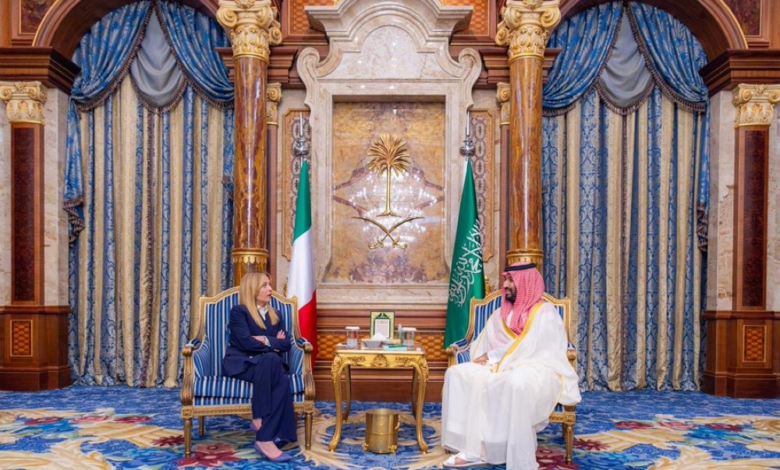
In the context of strengthening bilateral and diplomatic relations between the Kingdom of Saudi Arabia and the Italian Republic, His Royal Highness Prince Mohammed bin Salman bin Abdulaziz Al Saud, Crown Prince and Prime Minister, met today with Her Excellency Giorgia Meloni, Prime Minister of Italy, during her official visit to the Kingdom. This high-level meeting reflects the keenness of both leaderships to enhance cooperation in various vital fields and elevate it to broader horizons.
Details of the Italian Prime Minister's arrival in Jeddah
Italian Prime Minister Giorgia Meloni arrived in Jeddah earlier today. She was received at King Abdulaziz International Airport by His Royal Highness Prince Saud bin Mishaal bin Abdulaziz, Deputy Governor of Makkah Region. Also participating in the official welcoming ceremony were His Excellency the Mayor of Jeddah, Mr. Saleh Al-Turki; the Director of Makkah Region Police, Major General Saleh Al-Jabri; the Ambassador of the Republic of Italy to the Kingdom, Carlo Baldocci; and the Director General of the Royal Protocol Office in Makkah Region, Ahmed Abdullah bin Thafir.
Historical background of Saudi-Italian relations
This important visit comes within the context of a long history of close Saudi-Italian relations, dating back to 1932, when Italy was among the first countries to recognize the Kingdom and establish strong diplomatic ties. Over the decades, these relations have evolved into multiple strategic partnerships, making Italy one of the Kingdom's most important European partners today and an active contributor to its shared development.
Economic importance and alignment of visions with Vision 2030
This summit is of paramount economic importance, particularly given the rapid developments underway in the Kingdom as part of its Vision 2030.Italy is a key trading partner for Riyadh, and both countries are focused on expanding cooperation in vital sectors such as renewable energy, infrastructure, advanced technology, and tourism. Mutual investments also play a pivotal role in bolstering economic growth, as evidenced by the ongoing coordination between major companies and business communities in both countries to explore new investment opportunities.
Regional and international impact of the meeting
On both regional and international levels, the meeting between the Crown Prince and the Italian Prime Minister carries significant political and economic implications. Saudi Arabia plays a leading role in stabilizing global energy markets and supporting peace and security in the Middle East, while Italy is an influential voice within the European Union and the G7. This ongoing coordination between Riyadh and Rome contributes to addressing shared global challenges, including international maritime security, supporting geopolitical stability, and promoting sustainable development, which in turn positively impacts international peace and security.