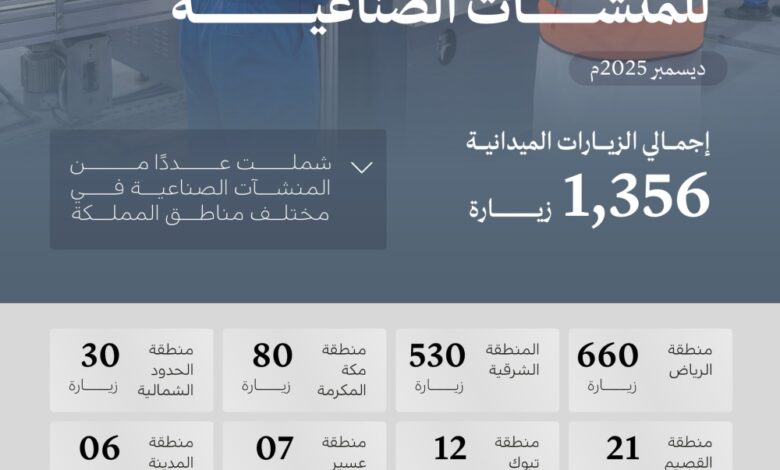
As part of its ongoing efforts to regulate the industrial sector and enhance compliance with national standards, the Ministry of Industry and Mineral Resources, represented by the Industrial Services and Compliance Agency, announced that it conducted 1,356 intensive field visits to industrial facilities across Saudi Arabia during December. These inspection tours are an integral part of the Ministry's strategy to ensure factories adhere to operational and environmental requirements and to guarantee the application of the highest quality and safety standards.
Geographical distribution reflecting industrial weight
The Ministry's official spokesperson, Jarrah bin Mohammed Al-Jarrah, revealed details of these visits, which covered all parts of the Kingdom. The Riyadh region topped the list with 660 visits, followed by the Eastern Province with 530, reflecting the significant industrial weight of these two regions, which are home to major industrial cities and large-scale projects. The tours also included 80 visits to Makkah, 30 to the Northern Borders region, and 21 to Qassim. The remaining visits were distributed among the regions of Tabuk, Asir, Madinah, Jazan, and Hail.
Strategic context: Vision 2030 and the National Industrial Strategy
These figures cannot be viewed in isolation from the Kingdom's overall economic context. These field visits are aligned with the objectives of Vision 2030 and the National Industrial Strategy, which aim to build a resilient, competitive, and sustainable industrial economy. Through these visits, the Ministry is working to improve the governance of the industrial sector, as compliance with regulations is a cornerstone for attracting foreign and domestic investment. Investors always seek a well-organized and transparent business environment subject to fair oversight that ensures fair competition for all parties.
The importance of compliance and its economic and environmental impact
These visits are of paramount importance, extending far beyond mere routine oversight. They aim to protect the environment from emissions and untreated industrial waste, and to ensure the safety of workers and communities surrounding industrial areas. Furthermore, quality control contributes to enhancing the reputation of Saudi products both domestically and internationally, thus opening up broader horizons for Saudi non-oil exports. Al-Jarrah emphasized that the Ministry is committed to taking legal action against violators, while simultaneously working to rectify the status of factories located outside industrial cities, ensuring their integration into the formal system.
Requirements: Sustainability Gateway
It is worth noting that the Ministry requires all industrial facilities to obtain a package of licenses to ensure the legality of their operations. These licenses include industrial permits, environmental permits, and safety and civil defense licenses. For sensitive sectors such as food and pharmaceuticals, approvals from the Saudi Food and Drug Authority are required, in addition to certificates of conformity from the Saudi Standards, Metrology and Quality Organization, to guarantee the delivery of safe and wholesome products to the end consumer.