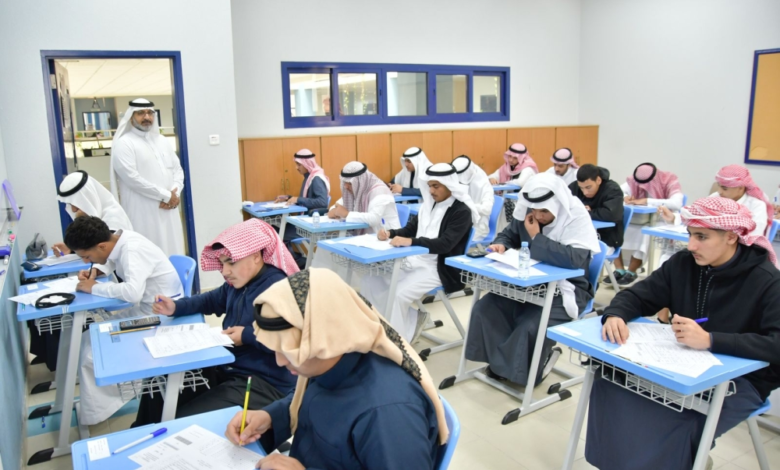

This morning, make-up exams (second session) began in all schools under the Ministry of Education in the Kingdom of Saudi Arabia. These exams are for students who missed the first semester final exams. They include all student groups who were unable to attend previously, whether their absence was excused by official and acceptable reasons or unexcused. Additionally, make-up exams for high school students in subjects they failed are also being held, in a step aimed at ensuring the smooth continuation of the educational process.
Approved Grade Distribution Mechanism
As part of organizing the assessment process, the Ministry of Education adopted a precise and detailed mechanism for calculating the scores of students taking the exams, in order to ensure educational fairness and equal opportunities. The scores were divided as follows:
- Students who are absent with an excuse: Their tests are evaluated out of 40 marks in the three educational stages, where the weighted mark is calculated based on their performance to compensate for what they missed.
- Students absent without excuse (secondary level): The Ministry has set a ceiling of 60 marks, in accordance with the regulations concerning unjustified absence.
- Failure subjects: High school students who have failed subjects from previous years will take exams in the parallel semester and will be evaluated out of 100 marks .
Organizational context and the importance of the Noor system
These tests are part of the Ministry of Education's organizational structure designed to ensure that students' academic progress is not disrupted by the emergency situation. Schools rely entirely on the "Noor" electronic system for recording grades and documenting cases, guaranteeing data accuracy and rapid processing. This system is the backbone of school administration in the Kingdom, allowing parents and students to monitor results instantly and transparently.
The deadline for adjustment and the strategic dimension
To ensure the protection of students' rights and the accuracy of results, the Ministry has granted school administrations a deadline of the 17th of Sha'ban (the eighth month of the Islamic calendar) to receive requests for grade adjustments for the first semester and to address any discrepancies in the recorded grades. This procedure provides schools with sufficient flexibility to review answer sheets and verify the accuracy of the data entry and recording processes before the system is closed.
At the national level, this educational mobilization serves the goals of the Kingdom's Vision 2030, particularly with regard to the Human Capital Development Program. Addressing the situations of struggling or absent students reduces educational waste, enhances the quality of educational outcomes, and reinforces the values of discipline and diligence as fundamental pillars for building a globally competitive generation.
The ministry stressed in its circulars to educational departments the need to strictly adhere to the specified timetables, with full commitment to monitoring and documentation standards, to ensure the smooth running of the educational process and the completion of students’ academic files without any delay.