Makkah Education honors 30 winners in the Mishkat Al-Nubuwwah competition for the Prophetic Sunnah

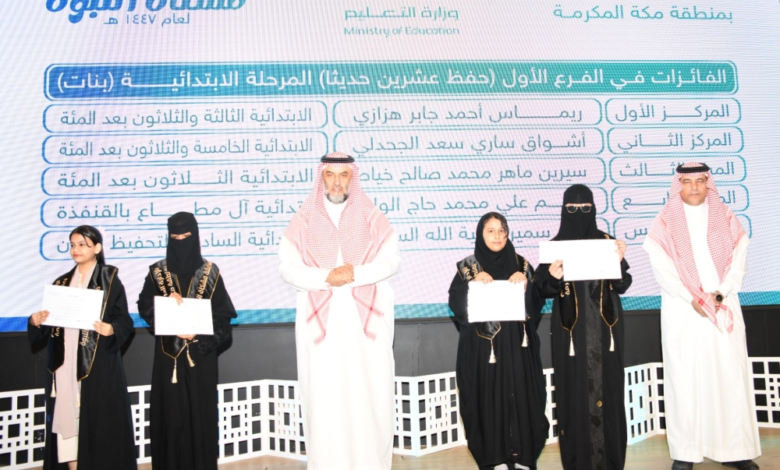
The General Directorate of Education in Makkah concluded the preliminary rounds of the “Mishkat Al-Nubuwwah” competition today with a celebratory ceremony honoring 30 winners, carefully selected from among 900 male and female students across various grade levels. This recognition culminated a period of qualifying rounds and fair competition held in a spirit of faith. The ceremony was attended by the Director General of Education in the region, Abdullah Al-Ghannam, the Assistant Director for Educational Affairs, Dr. Ali Al-Jalouq, and a number of educational leaders and parents.
Continuous attention to the sources of legislation
This competition comes within the framework of the great attention that the Kingdom of Saudi Arabia, represented by the Ministry of Education, pays to the preservation of the two sources of Islamic legislation: the Holy Quran and the purified Sunnah of the Prophet. Since its founding, the Kingdom has consistently sponsored Quranic and Hadith competitions, both locally and internationally, stemming from its status as the birthplace of revelation and the custodian of the Two Holy Mosques. The “Mishkat al-Nubuwwah” competition is an extension of this rich legacy, aiming to connect young people with the life of their chosen Prophet (peace and blessings be upon him) and his noble sayings, so that they may be worthy successors to the best of predecessors.
Competition details and levels
The competition targeted a wide range of students in public, private, and international schools, as well as Quran memorization schools in the Holy City of Mecca and the governorates of Al-Jumum, Bahrah, Al-Lith, and Al-Qunfudhah. The competition was divided into three main categories to ensure a gradual progression in knowledge acquisition
- Primary stage (upper grades): It was dedicated to memorizing 20 hadiths, to instill basic principles in the hearts of young children.
- The intermediate stage: included memorizing 30 hadiths, to enhance the students’ linguistic and legal knowledge.
- Secondary stage: It included memorizing the entire prescribed text, reflecting an advanced level of mastery and understanding.
Expected educational and social impact
The importance of the “Mishkat al-Nubuwwah” competition extends beyond mere competition to encompass profound educational and social dimensions. Locally, these events contribute to the intellectual fortification of youth, the strengthening of moderate Islamic identity, and the rejection of extremism and fanaticism through a correct understanding of religious texts. They also enhance students' proficiency in classical Arabic and develop their public speaking skills and self-confidence. Regionally and internationally, these outstanding student examples present a shining example of the outcomes of Saudi education, which combines tradition and modernity and is committed to building a well-rounded individual who takes pride in their faith and contributes to the development of their nation.
precise arbitration criteria
The competition was judged according to rigorous and transparent criteria, with 16 experienced and specialized judges evaluating the participants. The competition involved multiple stages to select the best and most accomplished entries, ultimately resulting in the selection of five winners from each category, reflecting the intensity of the competition and the high caliber of the participants. The ceremony concluded with the distribution of prizes and certificates of appreciation, encouraging the students to continue their pursuit of Islamic knowledge and the memorization of the Prophet's Sunnah.