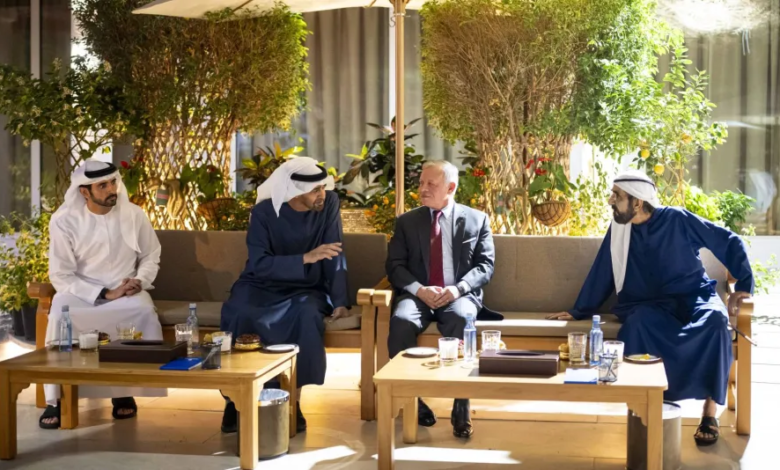

In the context of ongoing coordination and consultation between the two leaderships, His Highness Sheikh Mohamed bin Zayed Al Nahyan, President of the United Arab Emirates, and His Majesty King Abdullah II bin Al-Hussein, King of the Hashemite Kingdom of Jordan, held a bilateral summit to discuss avenues for joint cooperation and address key regional and international developments. These talks come at a critical juncture, as the Middle East faces rapidly evolving geopolitical challenges that necessitate a unified Arab vision and stance to ensure security and stability.
The depth of Emirati-Jordanian relations and their historical background
The relationship between the United Arab Emirates and the Hashemite Kingdom of Jordan is based on deep-rooted and enduring historical foundations laid by the late Sheikh Zayed bin Sultan Al Nahyan and King Hussein bin Talal, may God have mercy on them both. This strategic relationship has evolved over the decades to encompass various political, economic, and security fields. The ties between the two countries are characterized by a convergence of views on most regional issues, with both nations committed to strengthening joint Arab action, supporting peace efforts, and rejecting extremism and terrorism. Economically, the UAE is one of Jordan's largest investors and trading partners, reflecting mutual trust and a shared commitment to achieving sustainable development that benefits the people of both brotherly nations.
The importance of the talks and their impact on the regional landscape
Meetings between Sheikh Mohammed bin Zayed and King Abdullah II are of exceptional importance given the political and diplomatic weight their countries carry on the regional and international stage. Discussions consistently focus on the need to de-escalate tensions in the region, particularly in light of current crises, most notably the Palestinian issue. Both leaders emphasize in all forums the importance of finding a just and comprehensive political solution to the Palestinian question based on the two-state solution, ensuring the unimpeded delivery of humanitarian aid and relief to civilians, and sparing the region the ravages of war and open conflict.
Expected repercussions of the summit (locally, regionally, and internationally)
The expected effects of this high-level format can be summarized in several key ways:
- On the bilateral level (locally): to advance the comprehensive strategic partnership, increase the volume of trade exchange, and expand the prospects for cooperation in vital and future sectors such as advanced technology, renewable energy, and food and water security.
- On the regional level: Forming a cohesive Arab front capable of dealing with security and political challenges, supporting stability efforts in countries experiencing conflicts, and promoting dialogue and diplomacy as the only way to resolve disputes and overcome crises.
- On the international level: This sends a clear message to the international community about the need to uphold its legal and moral responsibilities towards maintaining security and peace in the Middle East. Furthermore, Emirati-Jordanian coordination represents a fundamental pillar upon which major powers rely in their efforts to de-escalate tensions and prevent the region from sliding into wider conflicts.
In conclusion, this meeting between His Highness Sheikh Mohammed bin Zayed Al Nahyan and His Majesty King Abdullah II embodies a model to be emulated in Arab-Arab relations, and affirms the two countries’ firm commitment to working together to build a more secure and prosperous future for all the peoples of the region, and to overcome current challenges with wisdom, competence and joint coordination.