
Conjunction of the Moon and Regulus (the Heart of Leo) 2026: A remarkable astronomical phenomenon

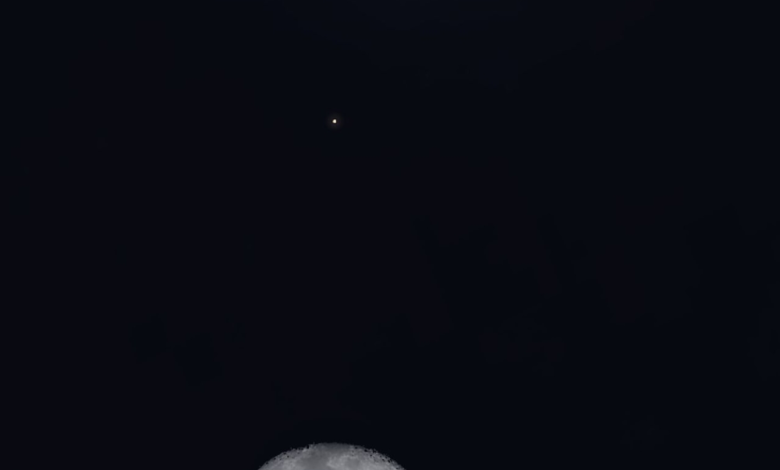
Astronomy enthusiasts and celestial observers across the Arab world will be turning their attention to the sky this evening, Tuesday, January 6, 2026, to witness a remarkable astronomical event. Engineer Majid Abu Zahra, President of the Jeddah Astronomical Society, announced a beautiful conjunction between the waning gibbous moon and the star Regulus (Alpha Leonis). This phenomenon presents an ideal opportunity for those interested in space science and astrophotography to capture a scene that combines Earth's natural satellite with one of the brightest stars in the sky, all visible to the naked eye.
Details of the astronomical phenomenon
Abu Zahra explained that this conjunction is a purely apparent phenomenon, where the two celestial bodies appear close together in the sky to an observer on Earth, while in reality, they are separated by a vast distance in space. While the Moon is at an average distance of about 384,000 kilometers from us, Regulus (the Lion) is located at an enormous distance of approximately 79 light-years. This significant difference in distances highlights the immensity of the universe and the precision of astronomical calculations that enable us to predict these alignments with remarkable accuracy.
Heart of the Lion: Amazing Scientific Facts
Regulus, the bright star of the first magnitude, is unique among bright stars as it lies almost on the ecliptic, the apparent path the Sun, Moon, and planets follow across the sky. It belongs to spectral class B7, meaning it is a bluish-white star, and its mass is about 3.5 times that of our Sun, while its true luminosity is approximately 300 times that of the Sun. One of Regulus's most remarkable physical characteristics is its extremely rapid rotation, which causes it to be flattened at the poles and bulge at the equator, giving it an elliptical shape rather than a perfect sphere.
Historical and cultural significance
Historically, Regulus, the bright star in Leo, held a prominent place in various ancient civilizations. The Greeks called it the "Royal Star" and considered it the king of the stars in its celestial region. The Arabs named it "Qalb al-Asad" (Heart of the Lion) because of its location at the heart of the constellation Leo, and it became associated in their cultural heritage with specific seasons and symbolic meanings related to timing and weather patterns. Regulus is also a key component of a constellation known as the Sickle, a pattern resembling an inverted question mark that marks the head and chest of a lion, making it easier for beginners to locate in the sky.
The value of astronomical observation
This event is a valuable educational opportunity, as observing the Moon's movement relative to the fixed stars behind it helps us understand celestial mechanics and the motion of celestial bodies in their orbits. Although the conjunction occurs periodically due to the star's position in the Moon's orbit, each instance has its own unique characteristics depending on the Moon's phase and atmospheric conditions. Astronomers recommend using binoculars to witness the beautiful contrast between the Moon's silvery glow and the star's blue brilliance, a spectacle that enhances our appreciation for the beauty and order of the universe.