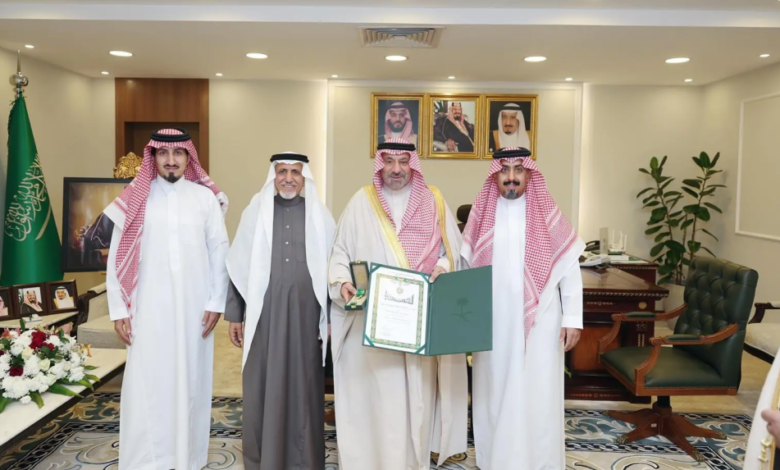
The Prince of Najran honors a citizen who donated his kidney to his father with the King Abdulaziz Medal

In a scene that embodies the highest meanings of righteousness and loyalty, and in confirmation of the values of family cohesion that characterize Saudi society, His Highness Prince Jalawi bin Abdulaziz bin Musaed, the Governor of Najran Region, honored citizen Hussein bin Ali Al-Hutaila in his office at the Emirate today, by awarding him the King Abdulaziz Medal of the Third Class .
This high honor came in implementation of the generous royal order, in appreciation of the citizen’s humanitarian and noble stance represented by his donation of one of his kidneys to his father, thus ending his father’s health suffering and writing an inspiring story of righteousness and benevolence.
Official praise for the values of righteousness and loyalty
During the reception ceremony, His Royal Highness the Prince of Najran praised the heroic act of Mr. Al-Hutaila, emphasizing that his actions exemplified the Islamic teachings that encourage kindness and respect towards parents. His Highness noted that such acts are not surprising from the people of Saudi Arabia, who are raised on the values of generosity and sacrifice, and whose society is characterized by strong family bonds and a robust social fabric, all under the wise leadership of the Kingdom – may God protect them.
Family pride and leadership appreciation
For his part, the donor's father expressed his deepest gratitude to the Custodian of the Two Holy Mosques, His Royal Highness the Crown Prince, and His Royal Highness the Governor of Najran Region for their unwavering support and dedication to charitable and humanitarian work. He emphasized that awarding his son the King Abdulaziz Medal, Third Class, is a source of immense pride and honor for him and his entire family, and a powerful incentive for all citizens to engage in humanitarian endeavors.
King Abdulaziz Medal: A symbol of national appreciation
The King Abdulaziz Medal is one of the highest honors in the Kingdom of Saudi Arabia, awarded by royal decree to recognize citizens who render distinguished service to the nation or perform exceptional acts of heroic or humanitarian sacrifice. The state typically reserves the third class of this medal for living organ donors or the relatives of brain-dead individuals, encouraging organ donation, a culture championed by the Kingdom through the Saudi Center for Organ Transplantation, with the aim of saving patients' lives and ending their suffering from organ failure.
Human and social dimensions
This event reflects the great importance Saudi Arabia places on the health and humanitarian sectors, as the country strives to promote a culture of social solidarity. Honoring organ donors at this high level sends a powerful message about the importance of charitable work and contributes to raising societal awareness of the need to help patients, aligning with the goals of the Kingdom's Vision 2030 to build a vibrant and resilient society.