New education regulations for exams: Teachers are prohibited from serving on committees for relatives

The Ministry of Education has approved a new administrative and organizational structure for managing final exams in schools, a move aimed at strengthening governance of educational processes and increasing transparency and integrity in evaluating students' academic achievement. This step is part of a series of development measures through which the Ministry seeks to ensure the quality of educational outcomes and guarantee equal opportunities for all students.
The context of educational reforms and the importance of governance
These new procedures are of paramount importance within the context of the transformations underway in the Kingdom's education sector, as the Ministry strives to align with the objectives of Vision 2030, which focuses on enhancing the quality of education and raising the efficiency of institutional performance. The governance of examinations is a fundamental pillar for ensuring the credibility of academic certificates, both domestically and in the context of university admissions and scholarships abroad. By separating personal relationships from assessment tasks, the Ministry strengthens the confidence of the community and parents in the education system and ensures that the grades awarded accurately reflect the student's level of knowledge without any external influences.
Conflict of interest ban: strict measures
To ensure maximum impartiality, the Ministry's new procedural guide imposes strict controls to definitively prevent conflicts of interest. The new regulations prohibit assigning any teacher or administrator to invigilate, mark, or audit classes in which a first-degree relative is enrolled. The regulations require school principals to redistribute these tasks and assign these individuals to other committees or classes completely unrelated to their family ties, thus eliminating any possibility of favoritism or social pressure that could influence the conduct of examinations.
New administrative structure: Academic Achievement Committee
The ministry adopted a unified hierarchical administrative model, beginning with the "Academic Achievement Committee" as the highest supervisory authority within the school, chaired by the school principal, to ensure the strict application of regulations. This central committee has four specialized executive arms, designed to cover all stages of the examination process
1. Control and Regulation Committee (Preparatory Phase)
The responsibilities of this committee, which is under the supervision of the Deputy Minister for School Affairs, include logistical aspects such as preparing the examination halls, distributing seating number posters, ensuring a conducive classroom environment by removing any teaching aids that could facilitate cheating from the walls, and securing the safe collection and storage of answer sheets before and after the exam.
2. Supervision and Observation Committee (Implementation Phase)
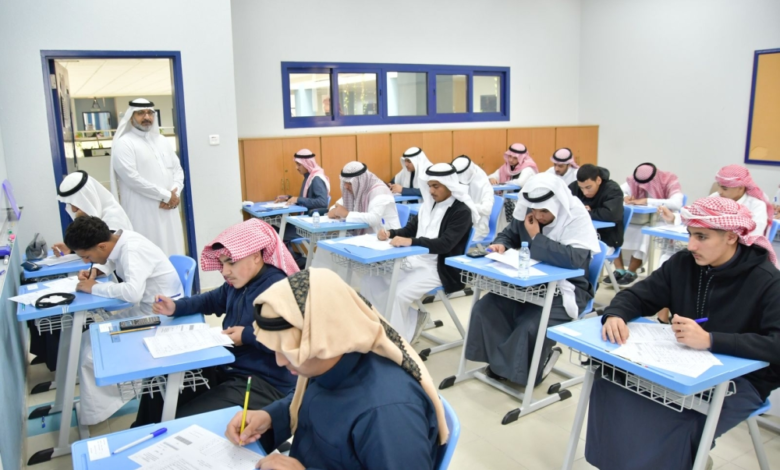
As soon as the exam bell rings, the Dean of Student Affairs assumes the chairmanship of the committee responsible for managing the examination hall. Its responsibilities include preparing and assigning invigilators, overseeing the timely opening of the exam papers, monitoring student entry and exit, accurately recording absences, and immediately documenting any violations that may occur within the examination halls.
3. Correction and Review Committee (Evaluation Phase)
After the students finish their work, the committee, headed by the Undersecretary for Educational Affairs, begins its work. The committee oversees the delivery of answer sheets to the examiners along with the approved model answers, and monitors the review and verification processes to ensure that each student receives their full due and to minimize the possibility of human error in grading.
4. Monitoring and Results Committee (Final Stage)
The process concludes with the work of the monitoring committee, also headed by the Undersecretary for Educational Affairs. This committee is responsible for entering the grades into the central electronic systems (Noor system) and generating the preliminary results. The committee then prints the final drafts and proofs and conducts a thorough verification of student data against their official documents before final approval of the results.