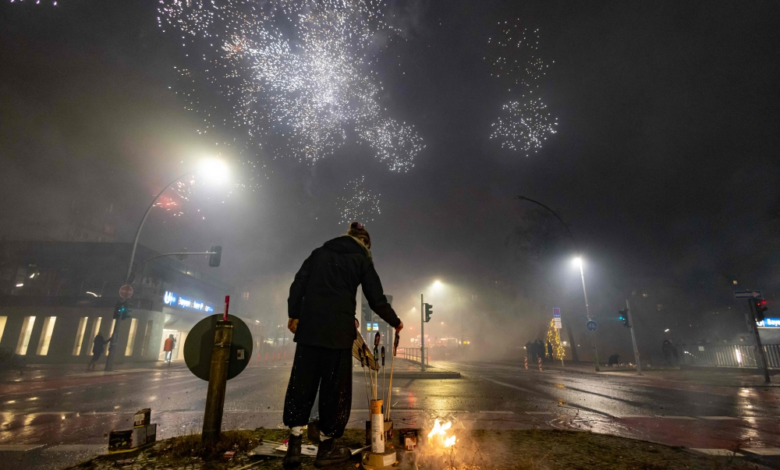

Germany experienced a tumultuous New Year's Eve that turned violent in several cities, resulting in two deaths and dozens of injuries, including police officers, as well as a wave of arrests targeting hundreds. These events have reignited the ongoing debate about regulations governing celebrations and the use of fireworks in the country.
Heavy toll in Berlin and Hamburg
In Berlin, the epicenter of the unrest, police announced the arrest of approximately 430 suspects following a series of coordinated and random attacks targeting security forces and firefighters. Security sources confirmed that 35 police officers sustained injuries of varying severity after being directly targeted with firecrackers and fireworks. Berlin was not alone in this; Hamburg also witnessed similar incidents in which 10 police officers were injured, prompting the deployment of over 3,200 additional officers in the capital and 1,000 in Hamburg to restore order.
Deaths and serious injuries from fireworks
In a tragedy that cast a shadow over the celebrations, two 18-year-old boys were killed in Bielefeld, western Germany. Police explained that the deaths resulted from the misuse of homemade firecrackers that exploded accidentally, causing fatal facial injuries. Meanwhile, a Berlin hospital treated more than 30 critical cases, with medical staff having to amputate fingers and parts of the hand in some cases, in addition to treating severe burns and eye and facial disfigurement.
The spread of violence and confrontations
The unrest spread to North Rhine-Westphalia, the most populous state, where police recorded 30 direct attacks on officers during 4,000 security operations that night. In Leipzig, Saxony, security forces confronted groups of rioters who used stones, paint-filled bottles, and fireworks as weapons against law enforcement, reflecting a dangerous escalation in the level of violence directed against the state.
The general context and renewed political debate
These events have deepened wounds that have yet to heal since last year's incidents, as Germany has recently been grappling with a growing phenomenon of attacks targeting aid workers and police during public celebrations. Observers note that the tradition of setting off fireworks (Böller), a part of German culture, is being exploited as a cover for riots and violence, presenting authorities with a significant challenge in balancing individual freedoms with public safety.
Repercussions and demands for stricter sanctions
These attacks sparked outrage in official and union circles. Andreas Roskov, a representative of the police union, told the newspaper Bild that what happened was "a serious attack on the rule of law," demanding swift and deterrent trials for those involved. These events are expected to increase political pressure to review laws regarding the possession and use of fireworks, amid growing calls for a complete ban on their sale to individuals to prevent a recurrence of such deadly incidents in the future.