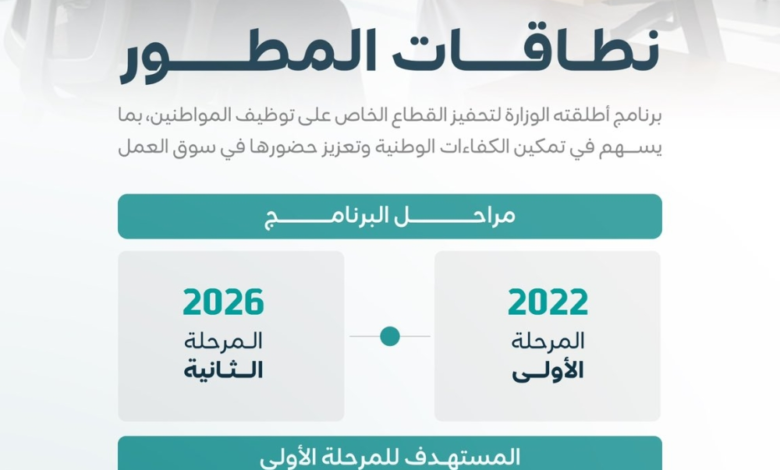

In a strategic move aimed at reshaping the Saudi labor market, the Ministry of Human Resources and Social Development has adopted the updated procedural guide for the “Developed Nitaqat” program for the year 2026. This step comes to reinforce the Kingdom’s efforts to raise the efficiency of the private sector and increase localization rates, in line with the objectives of the Kingdom’s Vision 2030, which seeks to create a sustainable and productive labor market.
Historical context: The evolution of the Nitaqat program
The Nitaqat program was not a spur-of-the-moment initiative, but rather the continuation of a journey that began in 2011 when the Ministry launched it as a tool to incentivize establishments to Saudize jobs. The program has undergone several developmental phases, evolving from direct quantitative Saudization to the "Developerated Nitaqat" program, which focuses on both quality and quantity. The 2026 update aims to address past challenges by integrating related economic activities and adopting a long-term Saudization plan that provides establishments with organizational stability, enabling them to strategically plan their human resources.
Color meanings in the developer's domains program
The updated version of the program relies on a precise classification mechanism that divides establishments into five color ranges based on their localization performance, and each color has its own characteristics or limitations:
1. Platinum Range (Peak)
This represents the highest level of commitment and excellence in localization. Establishments within this scope enjoy full government support, including:
- Instant calculation in the program.
- The possibility of transferring expatriate worker services from any other scope.
- Changing professions and renewing work permits with high flexibility, regardless of the remaining length of stay.
- Granting new visas for available professions.
2. High green zone
The establishments here enjoy advantages very close to the platinum range, as they are allowed to receive visa applications for productive professions, change professions, and renew licenses, which enhances their competitiveness and gives them great operational flexibility.
3. Medium green range
It is a safe and stimulating area, where establishments benefit from visa reception services, changing professions and renewing licenses, with immediate calculation continuing, but they are still required to improve to reach higher categories.
4. Low green zone (alert phase)
Constraints begin to emerge here to push the facility towards improvement:
- New visa applications are no longer being accepted.
- Requests to change professions have been suspended.
- Work permits for expatriate workers can only be renewed under specific conditions.
5. Red Zone (Danger Circle)
Establishments within this scope are subject to the strictest penalties for failing to meet the minimum localization requirements, including:
- Work permits for current workers will not be renewed.
- Prohibiting changes of professions or the transfer of new workers' services to it.
- New visa applications have been completely suspended.
The calculation mechanism and the expected economic impact
The procedural guide explained that the calculation of percentages is done through a precise mathematical equation based on the natural logarithmic function, taking into account the size of the establishment and its economic activity. This scientific approach ensures fairness between small, medium, and large establishments.
This update is expected to have a broad economic impact, not only reducing unemployment rates but also increasing the contribution of Saudi nationals to GDP and enhancing job stability. Preliminary data has shown the program's success in raising Saudization rates in vital sectors such as education, health, communications, and manufacturing, confirming the effectiveness of the implemented incentive policies.