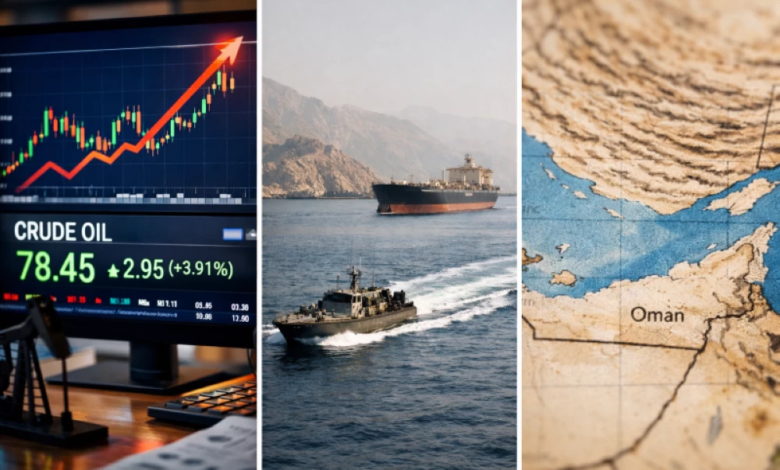
Global oil markets have entered a critical and unprecedented phase in pricing mechanisms, directly impacted by Iranian strikes targeting sites in the Gulf region. This radical shift has moved the global energy compass away from traditional supply and demand calculations and towards more complex equations linked to geopolitical security and the stability of supply chains in one of the world's most vital regions.
The return of the "war bonus" to the markets
Escalating military tensions have brought oil back to its traditional role as a key indicator of risk levels in the Middle East. Prior to this escalation, Brent crude had been trading relatively stable near $72 a barrel. However, recent military developments have forced investors and hedge funds to reassess the situation, adding what is known as a "war premium"—a hedging premium linked to concerns about production disruptions or threats to shipping lanes.
The strategic importance of the Strait of Hormuz
To understand the depth of the crisis, one must consider the region's geographical and economic context; the Arabian Gulf is a vital artery for global energy. Approximately 20% of the world's total liquid oil consumption passes through the Strait of Hormuz daily, making any security threat in this region a serious warning sign for the entire global economy. Energy market analysts believe the market has entered a phase of extreme sensitivity, where the security of maritime routes has become the primary driver of market indicators, overshadowing commercial inventory data or economic growth rates in major countries.
Price scenarios: $80 to $100
Energy experts and financial institutions predict three main scenarios for the next phase:
- Baseline scenario: Oil stabilizes at $80 a barrel in the near term, with political tensions continuing but no actual supply disruptions.
- Medium escalation scenario: If military operations expand and insurance costs for tankers rise, prices could jump to a range of $85 to $90 per barrel.
- The worst-case scenario: If shipping in the Strait of Hormuz is subjected to any direct disruption or partial closure, the markets could witness a sharp upward surge that breaks the $100 per barrel barrier as a result of the global "supply shock".
Expert opinion: Geopolitics is driving the market
In exclusive statements to Okaz newspaper, Saudi economic advisor Eid Al-Eid explained that the oil market has effectively entered a phase of "war economy." He emphasized that geopolitics has become the primary driver of prices, predicting that crude oil will quickly reach levels similar to the 1980s, with the risk premium remaining high in the coming period. Al-Eid added that any continued threat to energy routes will reinforce the upward trend and give prices additional momentum beyond conventional expectations.
Potential global impacts
The repercussions of this surge extend beyond the energy markets, casting a shadow over the global economy. Higher oil prices complicate the task of central banks worldwide in combating inflation, as increased energy costs lead to higher prices for goods, services, and transportation, potentially delaying anticipated interest rate cuts and further straining global economic growth.
Al-Eid concluded his remarks by emphasizing that oil has once again become a direct reflection of the military balances in the region; every escalation on the ground raises prices immediately, and every lull brings the market back to temporary stability, so that developments in the Gulf remain the decisive factor in shaping the future of energy and the global economy in the next stage.