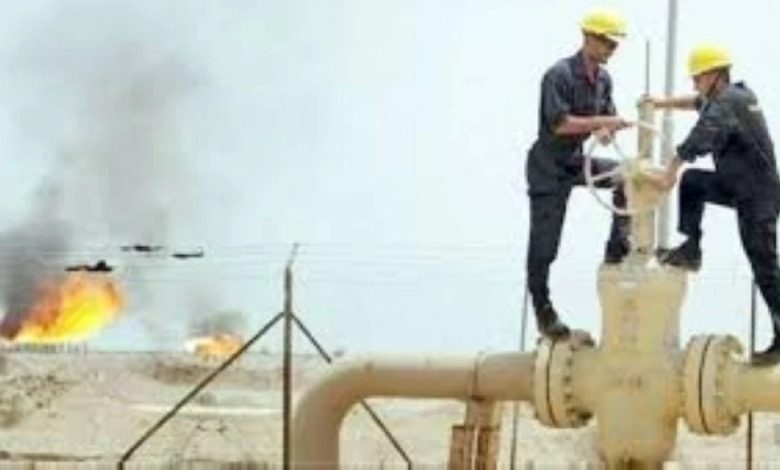

Global oil prices surged at the close of trading, reaching their highest level in over a week, driven by a wave of geopolitical tensions and concerns about global energy supplies. This sharp rise comes as a direct response to escalating US pressure on Tehran, coinciding with a sudden outage at one of Central Asia's largest oil fields.
Escalating tensions with Iran and their impact on markets
Recent political and military moves have played a pivotal role in stimulating markets, as US President Donald Trump intensified his maximum pressure campaign against Iran. These moves included imposing new rounds of stringent sanctions targeting ships and tankers transporting Iranian oil, in an attempt to cut off Tehran's oil revenues. Beyond economic sanctions, the announcement of a US naval fleet's deployment to the Middle East region raised investor concerns about potential disruptions in the Strait of Hormuz, a vital artery for global oil shipping, adding an immediate "risk premium" to prices.
Trading figures and weekly gains
These developments were immediately reflected on trading screens, with Brent crude futures for March delivery rising $1.82, or 2.8%, to settle at $65.88 a barrel, their highest level since mid-January. Similarly, West Texas Intermediate (WTI) crude futures climbed $1.71, or 2.9%, to close at $61.07 a barrel. Both benchmarks posted strong weekly gains exceeding 2.5%, recovering from earlier losses.
The Tengiz oil field crisis and the supply shock in Kazakhstan
Beyond the political tensions, the oil market faced a supply-side shock from Kazakhstan. A major international oil company announced that production at the giant Tengiz field, one of the world's largest, remains halted. This shutdown followed a fire that prompted the operator to suspend operations last Monday as a safety precaution.
This incident further complicates the oil landscape in Kazakhstan, whose oil sectors are already facing logistical challenges, most notably bottlenecks at the main export outlet via the Black Sea, which has previously been damaged by Ukrainian drone attacks, threatening the stability of oil flows from that vital region to global markets.
Analyst forecasts and market volatility
In a recent analytical note, JPMorgan painted a bleak picture of Kazakhstan's short-term production, indicating that the Tengiz field, which accounts for roughly 50% of the country's total output, may remain offline for the remainder of the month. The bank predicted that Kazakhstan's average crude oil production would fall to between 1 million and 1.1 million barrels per day in January, compared to its usual 1.8 million barrels per day, thus significantly reducing global supply.
It is worth noting that oil markets had previously experienced fluctuations influenced by President Trump’s statements regarding Greenland and trade threats to Europe. However, his reversal on imposing tariffs and ruling out military action contributed to a temporary calm, before prices rose again due to supply factors and tension with Iran.