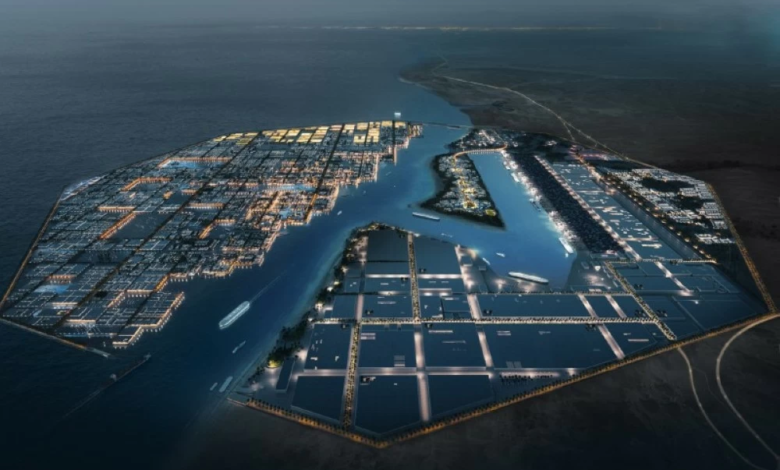

Recent international media reports have revealed rapid progress on the Oxagon project, the floating industrial city within the massive NEOM development. Satellite images show significant advancements in the port infrastructure, which is considered the lifeblood of this futuristic city. According to Newsweek, construction is proceeding at a rapid pace, underscoring Saudi Arabia's commitment to transforming its strategic vision into a tangible reality on the Red Sea coast.
A key pillar of Vision 2030
The Oxagon Port project is a cornerstone of Saudi Arabia’s Vision 2030, which aims to reduce dependence on oil and diversify the country’s sources of national income. Located within the $500 billion smart city of NEOM, the port’s site is currently the world’s largest construction site. Beyond its role as a transit point, the port is part of a comprehensive strategy to build an advanced maritime trade system that will enhance the Kingdom’s position as a global logistics hub connecting three continents: Asia, Africa, and Europe.
Future technologies: clean energy and full automation
What distinguishes the Port of Oxagon from other traditional ports is its complete reliance on next-generation technologies. The Kingdom plans to operate it as the world's first port powered entirely by renewable and clean energy, reflecting Saudi Arabia's commitment to global environmental standards and combating climate change. Furthermore, the port's logistics operations will rely on fully automated, AI-powered operating systems, ensuring unprecedented handling efficiency and speed of execution, while minimizing human error.
Construction developments and international partnerships
On the implementation front, reports indicate that the Belgian international construction company BESIX has shifted its operational focus to the site to complete the major marine works. These works include the construction of 4 kilometers of state-of-the-art quays and 7 berths with depths ranging from 10.5 to 18.5 meters, enabling the port to accommodate the world's largest container ships. The project also includes a massive 900-meter-long terminal, reflecting the scale of the infrastructure development underway.
Strategic and economic importance
The Port of Oxagon derives its importance from its strategic location on the Red Sea, through which approximately 13% of global trade passes. The port is expected to handle around 1.5 million TEUs (twenty-foot equivalent units) annually, thus strengthening global supply chains. The port has already proven its efficiency, with NEOM management announcing its success in handling international shipments, such as a shipment from Egypt to Iraq, which reduced transit time by 50% compared to traditional routes, underscoring the project's significant economic viability.
Future prospects
As initial operations continue, attention is now focused on early 2026, the anticipated date for the full operation of the integrated container terminal. This date marks a turning point for the logistics sector in the Middle East, as Oxagon will officially open its doors to global maritime shipping, ushering in a new era of smart and sustainable trade.