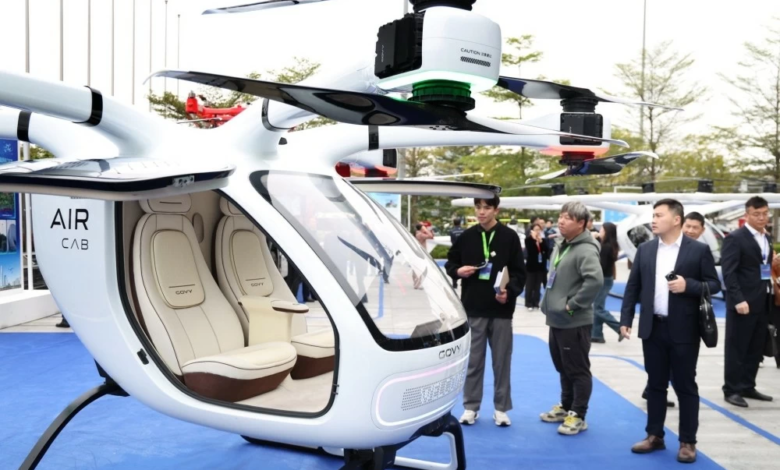

A recent report published by the Chinese newspaper "Economy Daily" revealed a significant leap forward in the drone industry, with numerous major technology companies worldwide racing to develop drones to unprecedented levels of advancement, transcending their traditional uses in photography and surveillance. The report explained that several of these companies have already succeeded in creating drones specifically designed for passenger transport, and live demonstrations of these advanced vehicles were showcased at a specialized aircraft exhibition, heralding the imminent arrival of the "flying taxi" era.
Rapid technological development in urban air transport
This development comes within the context of what is known globally as "Urban Air Mobility" (UAM), a concept that aims to solve the crippling traffic congestion in major cities by utilizing low-altitude airspace. Drones are no longer just toys or military tools; they have transformed into electric vertical takeoff and landing (eVTOL) vehicles capable of carrying passengers and transporting them within cities quickly and efficiently, relying on clean energy to reduce carbon emissions.
From science fiction to tangible reality
Historically, the idea of flying cars or individual airborne vehicles was the stuff of science fiction seen in movies. However, the tremendous advances in battery technology, autonomous navigation systems, and artificial intelligence over the past decade have made this dream a tangible reality. China is one of the leading countries in this field, with its companies investing heavily in infrastructure and research and development to produce safe and reliable drones for transporting people.
Expected economic and social impact
The proliferation of passenger drones is expected to fundamentally transform daily life and the global economy. Locally, this technology will reduce travel time between city centers and suburbs from hours to mere minutes. Economically, this industry is anticipated to create a multi-billion dollar market encompassing manufacturing, maintenance, air traffic management, and the development of takeoff and landing platforms atop skyscrapers and critical buildings.
Future challenges
Despite the considerable optimism expressed in the report and the presentations at specialized exhibitions, several challenges remain before full reliance on this technology can be achieved. Chief among these are the development of stringent international regulations and laws to ensure passenger safety, the regulation of air routes to prevent accidents, and the improvement of battery efficiency to guarantee longer flight distances. Nevertheless, the display of these prototypes confirms that the future is closer than we imagine.