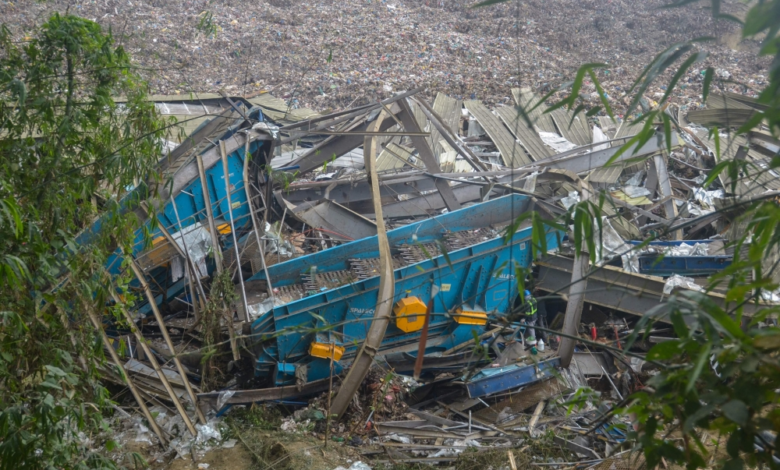

Rescue teams in the Philippines continued their arduous and perilous search on Saturday, using bulldozers and heavy equipment, hoping to find survivors buried under tons of rubble after a massive garbage dump collapsed in the central part of the country. The tragic disaster buried dozens of sanitation workers, with at least six confirmed dead so far.
Details of the Cebu disaster
The incident occurred last Thursday when a large section of a garbage dump at a private facility in the Benaleo area of Cebu City collapsed, burying residential buildings housing employees and workers on the site. According to a city council member, the piles of trash at the dump were nearly as high as a 20-story building, making the collapse extremely destructive.
Dave Tomolac, an official with Cebu City Council, told AFP that emergency teams had recovered six bodies, while 32 people remained missing, with fears that their chances of survival were diminishing as time passed. Local sources confirmed that the victims were inside their residences at the facility when the collapse occurred.
Challenges facing rescue teams
The rescue operations face enormous logistical and environmental challenges. Jo Reyes, a member of the rescue team, said that personnel face a real risk of further collapses of the unstable debris and waste. She added, "Operations are ongoing, but we have to stop from time to time to ensure the safety of the rescuers, as the landfill shifts due to pressure and the layers becoming loose.".
The situation is further complicated by the presence of heavy steel fragments and metal structures mixed with the rubble, hindering the work of bulldozers and requiring extreme caution to avoid injuring any potential survivors. Despite these conditions, teams managed to rescue at least 12 employees alive and transport them to hospitals for treatment.
Historical context and the waste management crisis
This incident is not the first of its kind in the Philippines, bringing back painful memories of similar disasters that highlighted the country's waste management crisis. Perhaps the most notorious of these was the infamous Payatas landfill collapse in Quezon City in 2000, which killed hundreds of impoverished people who lived and worked at the site. That tragedy prompted the government to enact new legislation, most notably the Solid Waste Environmental Management Act of 2000.
These recurring incidents reflect the structural challenges facing the Philippines as a developing archipelago nation experiencing rapid population and urban growth, generating enormous quantities of waste that exceed the capacity of existing infrastructure to absorb and safely process it. Impoverished communities are often forced to work and live in or near these dumps to earn a living by recycling materials, exposing themselves to serious health and environmental risks.
The aftermath of the incident and the investigations
City officials noted that communication with the disaster site was difficult due to signal outages, which slowed the flow of information in the initial hours. Authorities are expected to launch a comprehensive investigation into safety standards at the Benaleo landfill, examining the operator's compliance with worker housing regulations and site safety measures against landslides, particularly given the tropical climate which can further destabilize the soil and waste.