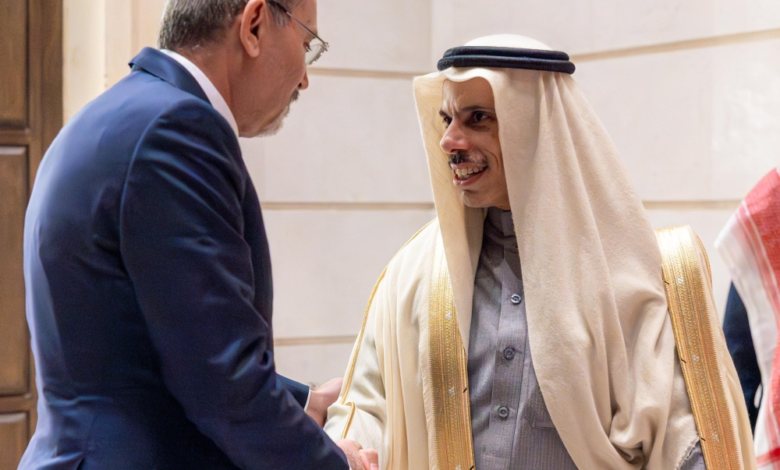
The Foreign Minister discusses with Safadi strengthening relations and regional developments

In a move to strengthen fraternal ties and joint Arab action, His Highness Prince Faisal bin Farhan bin Abdullah, Minister of Foreign Affairs, received Ayman Safadi, Deputy Prime Minister and Minister of Foreign Affairs and Expatriates of the Hashemite Kingdom of Jordan. This meeting reaffirms the deep-rooted and historically strong Saudi-Jordanian relations, based on bonds of kinship, neighborliness, and a shared destiny that unites the two leaderships and their brotherly peoples.
Dimensions of Saudi-Jordanian relations
The meeting included a comprehensive review of the fraternal and historical relations between the two countries, with both sides discussing ways to develop and elevate them to broader levels across various political, economic, and security fields. Relations between Riyadh and Amman are characterized by a high level of coordination, reflected in the continuous communication between the leaderships of both countries and the tireless work of the Saudi-Jordanian Coordination Council, which aims to institutionalize cooperation and develop strategic partnerships in a way that serves the interests of both countries and enhances the well-being of their peoples.
Coordinating positions on regional issues
On the political front, the two ministers discussed the latest regional and international developments. The talks focused on the importance of intensifying joint efforts to enhance security and stability in the Middle East and to address the current challenges facing the region. Saudi-Jordanian coordination is a cornerstone of Arab diplomacy, particularly concerning the Palestinian issue, where the two kingdoms share a common vision on the necessity of finding a just and comprehensive solution that guarantees the rights of the Palestinian people. They also discussed other issues related to Arab national security and combating terrorism.
The importance of timing and implications
This meeting is of particular importance given the delicate circumstances the region is experiencing, which necessitate Arab unity and coordinated diplomatic positions. The Saudi Foreign Minister's reception of his Jordanian counterpart reflects the Kingdom of Saudi Arabia's unwavering commitment to ongoing consultations with its brothers in Jordan, aimed at developing shared visions that contribute to reducing regional tensions and supporting development and peace initiatives. At the conclusion of the meeting, both sides affirmed their continued bilateral coordination on all issues of mutual interest.