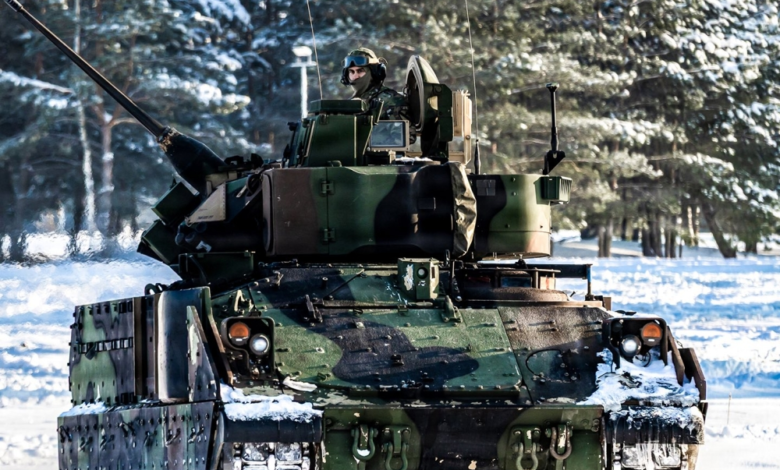

The German coast along the Baltic Sea witnessed the launch today of massive military exercises involving thousands of NATO troops, a move described by observers and military officials as a firm message reflecting the alliance's readiness to deter any potential threats from Russia. These drills come at a time of unprecedented geopolitical tensions in Europe, necessitating a heightened state of combat readiness for joint forces.
Details of the maneuvers at Potloth Field
The exercises, involving naval and special forces, focused on scenarios for controlling beaches and securing coastal areas. The main events took place at the Potloth military training range near the coastal city of Kiel. These activities are part of Steadfast Dart 2026, one of the largest exercises designed to test the Alliance's ability to rapidly move forces and equipment across member states' territories to reinforce forward positions.
Broad international participation and advanced equipment
Around 3,000 troops participated in these maneuvers under the command of German General Ingo Gerhartz. The exercises were characterized by the diversity of forces and equipment, with German Eurofighter jets providing air cover and 15 naval vessels participating in the operations. On land and at sea, the role of combat divers from the Spanish forces was prominent, along with specialized Turkish units using Zaha amphibious assault vehicles, reflecting the high level of coordination among the member states' armed forces.
The strategic importance of the Baltic Sea
The Baltic Sea has gained paramount strategic importance for NATO, especially after Finland and Sweden joined the alliance, effectively transforming it into something resembling an "Atlantic lake," with the exception of the Russian enclaves. These exercises underscore the alliance's commitment to defending every inch of its territory and upholding the principle of collective defense. Experts believe that training for amphibious operations in this region is vital to ensuring that supply lines remain open and that member states on the alliance's eastern flank are protected.
Official statements and political messages
Commenting on the event, German Defense Minister Boris Pistorius, who observed the exercises firsthand, stated that these drills demonstrate NATO's unity and readiness to act at any moment. "Especially in the Baltic Sea, the security situation has deteriorated significantly," Pistorius said, adding that this type of exercise underscores the alliance's seriousness regarding deterrence. These remarks clearly indicate that the alliance is no longer solely focused on managing crises beyond its borders, but has returned strongly to its core doctrine of regional defense and confronting rival great powers.
These military moves reflect a radical shift in Western military doctrine in recent years, with a focus on speed in military mobilization and integration between land, sea and air forces to ensure qualitative superiority in any potential future confrontation.