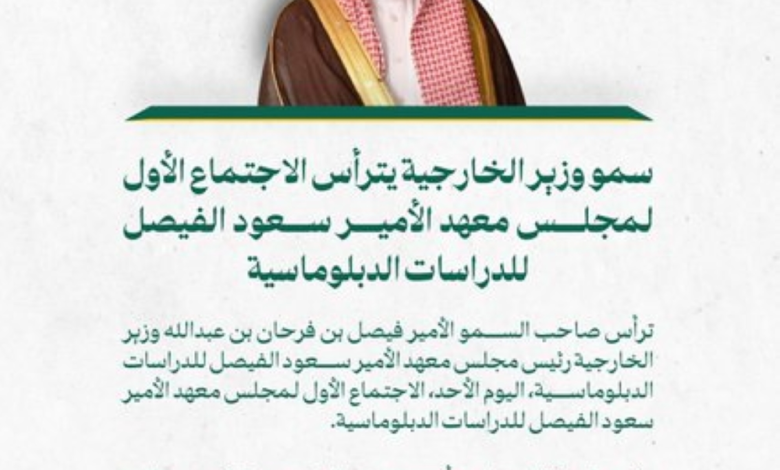
Foreign Minister chairs meeting of Prince Saud Al-Faisal Institute: New strategy

His Royal Highness Prince Faisal bin Farhan bin Abdullah, Minister of Foreign Affairs and Chairman of the Board of Directors of the Prince Saud Al-Faisal Institute for Diplomatic Studies, chaired today the first meeting of the Institute's Board of Directors in its new formation. This meeting is a pivotal step in the development of Saudi diplomatic work. His Royal Highness began the meeting by congratulating Their Highnesses and Excellencies, the members of the Board, on the issuance of the Cabinet's decision to reconstitute the Board, wishing them success in their duties to serve the Kingdom's foreign policy.
Reviewing the strategic vision and keeping pace with Vision 2030
The meeting included extensive discussions on the institute's future vision, reviewing its core objectives and planned strategic programs. The council focused on mechanisms to develop the institute's operational framework to ensure full alignment with the goals of the Kingdom's Vision 2030. These plans aim to enhance institutional performance and achieve a qualitative leap in the institute's output, positioning it as a key source of qualified national talent for Saudi diplomacy.
Prince Saud Al-Faisal Institute: A rich legacy and a renewed role
The Prince Saud Al-Faisal Institute for Diplomatic Studies occupies a prominent place in the history of Saudi diplomacy. Since its establishment, the Institute has played a vital role in training Saudi diplomats and equipping them with the necessary theoretical and practical skills. The Institute bears the name of the late Prince Saud Al-Faisal, the dean of diplomacy, in commemoration of his distinguished career and his significant contributions to serving the causes of the Arab and Islamic nations. The current meetings build upon this rich legacy, integrating modern tools and advanced training techniques to address evolving geopolitical challenges.
The importance of developing human and diplomatic capabilities
The significance of this meeting and its resulting decisions lies in their strong focus on human capital. Through its new strategy, the Institute seeks to build a national diplomatic force with advanced skills in political analysis, negotiation, international relations, and international law. This investment in human capital is a cornerstone for supporting the Kingdom's active and influential presence in international forums, particularly given Saudi Arabia's growing leadership role on both the regional and international stages, in both political and economic spheres.
Enhancing the Kingdom's international presence
At the conclusion of the meeting, it was emphasized that the Institute's outputs should directly contribute to strengthening the Kingdom's soft power and supporting the Ministry of Foreign Affairs' efforts to build bridges of communication with countries around the world. Developing the Institute's curricula and training programs will undoubtedly contribute to graduating a new generation of diplomats capable of representing the Kingdom effectively, defending its interests, and contributing to global peace and stability, thus reflecting the true and bright image of the Kingdom of Saudi Arabia.