The full moon of Ramadan 1447 AH graces the Arab skies tonight: Details of the Lavender Moon

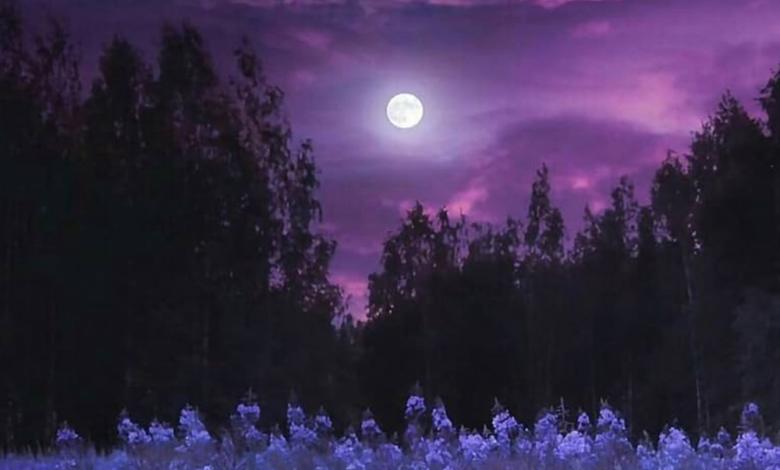
The Jeddah Astronomical Society, through its president, Engineer Majid Abu Zahra, announced that the skies of Saudi Arabia and the Arab world will witness the appearance of the full moon of Ramadan on Tuesday evening, the 14th of Ramadan 1447 AH, corresponding to March 3, 2026. This phenomenon is one of the most beautiful monthly astronomical sights that can be observed with the naked eye, as the moon adorns the sky throughout the night in a scene that combines spirituality and natural beauty.
Details of the Ramadan full moon phenomenon
Engineer Abu Zahra explained that the moon will rise just as the sun sets from the eastern horizon and will continue to grace the sky until it sets with the sunrise the following day. He noted that the moment of full moon will occur at 2:37 PM Mecca time, when the moon will have completed half its orbit around the Earth, and the Earth will be positioned precisely between the sun and the moon at an angle of 180 degrees—a phenomenon known astronomically as "opposition.".
Although the moment of astronomical fullness occurs at a specific time, the moon will appear to observers as a full, perfectly round moon throughout the night, giving astronomy and photography enthusiasts the perfect opportunity to document this event.
Badr Al-Khuzami: An Icon of Spring
In linking astronomical phenomena to the local environment, the head of the Jeddah Astronomical Society pointed out that the most fitting local name for the March full moon is "the Lavender Moon." This name is inspired by the lavender flowers (wild lavender), which are an icon of spring in the Najd and northern regions of the Kingdom. At this time of year, the deserts are draped in the purple hue of these flowers, whose fragrant aroma fills the night air, creating a strong cultural and historical connection between moonlight and the flourishing nature of the Arabian Peninsula.
The illusion of the moon and the interpretation of the color red
The moon is expected to appear larger than usual as it rises near the horizon, a phenomenon known as the "moon illusion." This is an optical illusion explained by the human mind and has no relation to the moon's actual size. The moon may also appear reddish or orange in the early morning hours due to the composition of Earth's atmosphere, which scatters shorter wavelengths of light (blue light) and allows longer wavelengths (red light) to pass through—the same physics that makes us see the red twilight at sunset.
The importance and impact of astronomical observation
Observing full moons holds special significance beyond their visual beauty; the midpoint of the lunar month is a crucial time for refining astronomical calculations and confirming the Islamic calendar. The full moon of Ramadan, in particular, is an important time marker for those fasting, indicating the midpoint of the holy month and the beginning of the countdown to the last ten days. This period also provides an excellent opportunity for astronomers to study the lunar surface features, as radiation craters like Tycho become relatively clear, although the vertical illumination may reduce the contrast of shadows.
As the night progresses, the moon will gradually rise, reaching its zenith (highest point in the sky) around midnight, before beginning its descent towards the western horizon. Over the next few nights, moonrise will be delayed by approximately 50 minutes each day, and it will enter its last quarter phase after about a week, making it visible in the early morning hours.