The conjunction of the Ramadan moon and the Pleiades in 2026... an astronomical phenomenon adorning the skies of the Arab world

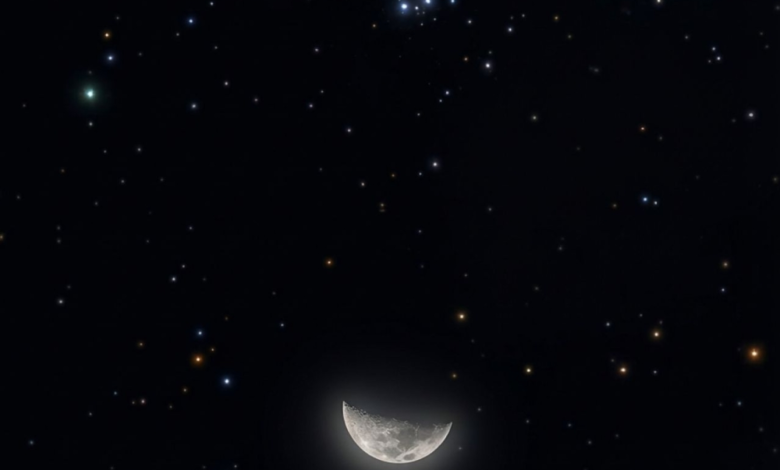
The Jeddah Astronomical Society, through its president, Engineer Majid Abu Zahra, announced that the skies of the Arab world will witness a unique astronomical phenomenon on the evening of Monday, February 23, 2026, as the conjunction of the crescent moon of the holy month of Ramadan with the Pleiades star cluster will be observed, in a magnificent celestial display that can be seen with the naked eye or using simple optical instruments.
Details of the astronomical phenomenon
Engineer Abu Zahra explained that the moon will appear in its waxing phase, positioned near the Pleiades star cluster, one of the brightest and most famous open star clusters in the northern sky. This phenomenon offers observers and astronomy enthusiasts an ideal opportunity to contemplate the beauty of the winter sky, with observation beginning immediately after sunset and the onset of night, and the spectacle continuing for several hours before the two celestial bodies disappear.
The Pleiades: The Seven Sisters in Science and Heritage
The Pleiades star cluster, scientifically known as M45, is located in the constellation Taurus. The head of the Astronomical Society pointed out that this cluster is not merely a random collection, but a relatively young star cluster comprising hundreds of stars bound together by gravity. Despite containing hundreds of stars, only seven are the brightest, which is why the ancient Arabs called them "the Seven Sisters.".
Physically, this cluster is characterized by the bright blue color of its stars, a result of the intense heat of these giant stars. The cluster is located approximately 440 light-years from Earth. Open clusters like the Pleiades are less tightly bound than globular clusters, meaning their stars will gradually drift apart and separate over millions of years, eventually floating freely in the Milky Way galaxy.
Tips for astrophotography and astrophotography
Regarding observation, the Jeddah Astronomical Society explained that the moon's bright glare may slightly obscure the view of faint stars in the cluster with the naked eye, especially in light-polluted cities. Therefore, using binoculars or small telescopes is recommended for a clearer and more detailed view, where the cluster will appear as scattered diamonds next to the crescent moon.
For amateur astrophotographers, this event represents a golden opportunity. By using long exposure camera techniques, details invisible to the naked eye can be revealed, such as the blue reflection nebulae surrounding the Pleiades stars, which are remnants of cosmic dust and gases from which these stars were formed, adding a captivating aesthetic to the captured images.
Conjunction: A Cosmic Geometric Perspective
Abu Zahra concluded by emphasizing that the conjunction phenomenon does not imply a real physical proximity between the Moon and the Pleiades in space. The Moon is only about 384,000 kilometers away from us, while the Pleiades are hundreds of light-years away. What we see is merely an apparent alignment of celestial bodies on a single line of sight for an observer on Earth. Nevertheless, these phenomena remain a wonderful way to connect with the universe and offer moments of tranquility and reflection, especially during the nights of the holy month of Ramadan.