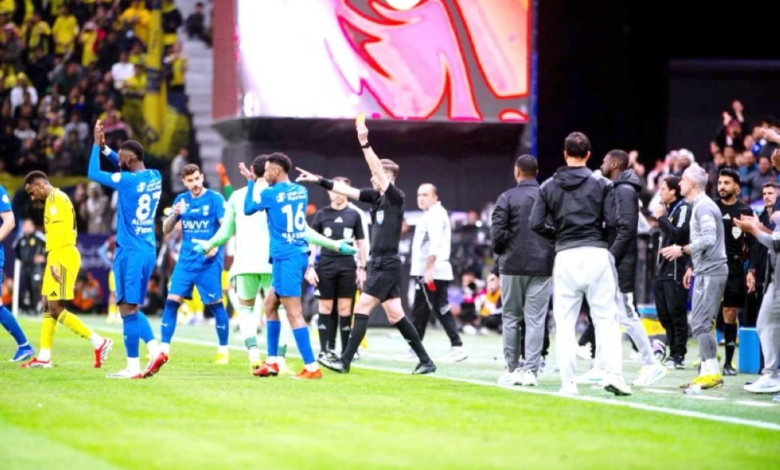

Football stadiums, those arenas dedicated to fair competition and sporting excellence, often transform into battlegrounds of controversy and heated debate, frequently sparked by a referee's whistle or a red card. "Expulsion" decisions are no longer merely punitive measures on the pitch; they have become pivotal turning points, shifting the balance of power in matches and raising a storm of questions about the standards of refereeing fairness, especially with the increasing reliance on modern technology.
The evolution of refereeing and the introduction of Video Assistant Referee (VAR) technology
Historically, referees' decisions were final and not subject to immediate review, leaving ample room for human error that could alter the course of entire tournaments. With the introduction of Video Assistant Referee (VAR) technology to the world of football, fans were optimistic about reducing egregious mistakes. However, reality has shown that technology, despite its accuracy, does not completely eliminate controversy, as the legal interpretations of video footage remain subject to human judgment. This creates differing opinions among referees and analysts, directly impacting the overall atmosphere of local and international competitions.
An artistic perspective: Between legal text and public emotion
In this context, sports expert and fitness coach Captain Ali Al-Mahmoud believes that the recurring debate surrounding red cards and the use of video technology reflects a gap in understanding modern refereeing mechanisms. Al-Mahmoud points out that differing viewpoints are healthy and natural in football, but they become a real problem when based on emotion and passion rather than a precise reading of the Laws of the Game.
Regarding the phenomenon of players protesting, Al-Mahmoud stressed: “Verbal or behavioral attacks on the referee are completely unacceptable and contrary to the spirit of sportsmanship. The referee is the judge of the field, and his discretionary decisions must be respected, as violent protesting does not change the decision but rather harms the image of the player and the team, and negatively affects the course of the match.”.
When does VAR intervene? And is the referee obligated to use it?
Al-Mahmoud clarified a crucial point often overlooked: the referee is not obligated to consult the VAR monitor for every single incident. The international protocol for the technology stipulates its intervention only in cases of "clear and obvious errors," namely:
- The validity of the goals (the presence of an offside or a foul before the goal).
- Penalty kicks.
- Direct dismissal cases.
- The error was in identifying the sanctioned player.
He stressed that not referring to VAR is not a mistake in itself if the referee is correctly positioned and confident in his decision.
Reversing the expulsion: strength or weakness?
Regarding the possibility of rescinding a red card, Al-Mahmoud pointed out that a referee's reversal of his decision after reviewing the footage is a sign of strength and integrity, not weakness. This occurs when the replay proves there was no violent contact, or that the foul only warranted a caution (yellow card), thus restoring justice and protecting the match from potentially unfair decisions.
Tactical influence and the right to object
Captain Al-Mahmoud concluded his remarks by emphasizing the profound impact of red cards, explaining that they disrupt the numerical balance and force coaches to abandon their tactical plans and resort to defense, thus granting the opponent a psychological and technical advantage. He also noted that clubs have the full right to file official complaints through legal channels after the match, avoiding media defamation. Disciplinary committees can review cases and rectify injustices if proven, which underscores the importance of promoting a culture of refereeing among all stakeholders in the game.