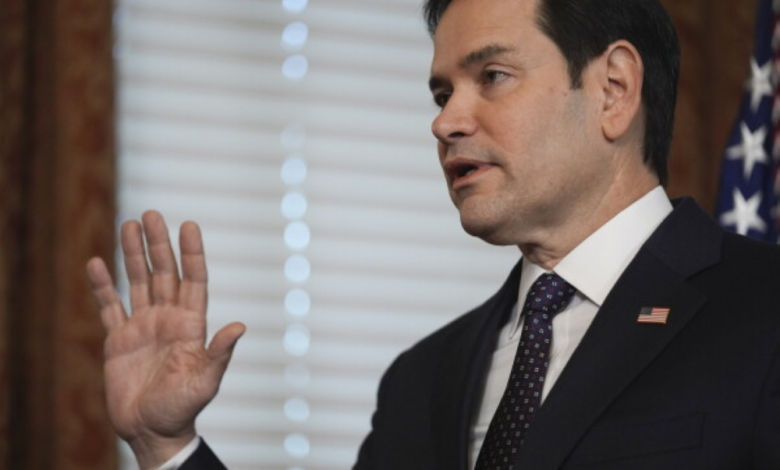

In what appeared to be a justification for not including nuclear issues in the initial understanding, Rubio told the New York Times on Sunday: “We are not putting it off. Nuclear talks are very technical matters. A nuclear issue cannot be resolved in 72 hours.”.
He stressed that nothing had changed, adding: “President Trump has been clear, Iran will never get a nuclear weapon, and Washington prefers to ensure that through diplomatic means.”.
He stressed that reaching an agreement on the nuclear issue will take some time; it cannot take years, but it will require some time to resolve the technical issues.
Rubio continued: We now have 7 or 8 countries in the region that support this approach, and we are ready to move forward.
Washington will not rush the agreement
Rubio, who was visiting India, had earlier told reporters that good news regarding Iran was expected within hours, before President Donald Trump downplayed the significance of the matter by indicating that Washington would not rush into an agreement with the Islamic Republic.
The United States has not officially disclosed details of the understanding being worked on, while Iranian Foreign Ministry spokesman Esmail Baghaei indicated on Saturday that a 14-point memorandum had been prepared, stipulating an end to the war, with discussions on contentious issues, most notably Iran's nuclear program, to be postponed for a later stage of 30 to 60 days.
optimistic rush
Since Saturday, Washington and Tehran have spoken of an imminent agreement to end the war that erupted in the Middle East following the US-Israeli attack on the Islamic Republic on February 28.
However, the optimistic momentum surrounding this agreement was tempered on Sunday by statements from Trump, who said that the negotiations were proceeding in an orderly and constructive manner, and that he had instructed his representatives not to rush into a deal, adding, "Time is on our side."
Rubio had said on Sunday morning, "There is a possibility that the world may receive good news in the next few hours."
He explained that the anticipated agreement would allay US concerns regarding the Strait of Hormuz, which Iran had effectively closed in response to the US-Israeli attack.
He added that the agreement would also mark the beginning of a process that would ultimately lead to what the president desires: a world that no longer fears or worries about an Iranian nuclear weapon.
US criticism of the potential agreement
The potential understanding drew criticism from Trump supporters, including Senator Ted Cruz and Mike Pompeo, Trump's Secretary of State during his first term.
Cruz and Pompeo are staunch supporters of Israel and have stated their opposition to granting Iran concessions such as allowing it to sell its oil. Cruz said the outcome could be a catastrophic mistake.
In response to these criticisms, Rubio said: "No one in the history of the United States has been tougher on Iran than Trump, through the war called Epic Wrath."
He added: "When this conflict with Iran began, the objectives were specific, simple, and very clear: to destroy their naval power, and that's what we did."
Rubio continued that Washington also sought to significantly reduce Tehran's ballistic missile capabilities and damage its defense industrial base.
He concluded: "Those were the objectives of Operation Epic Wrath, and those objectives were achieved."