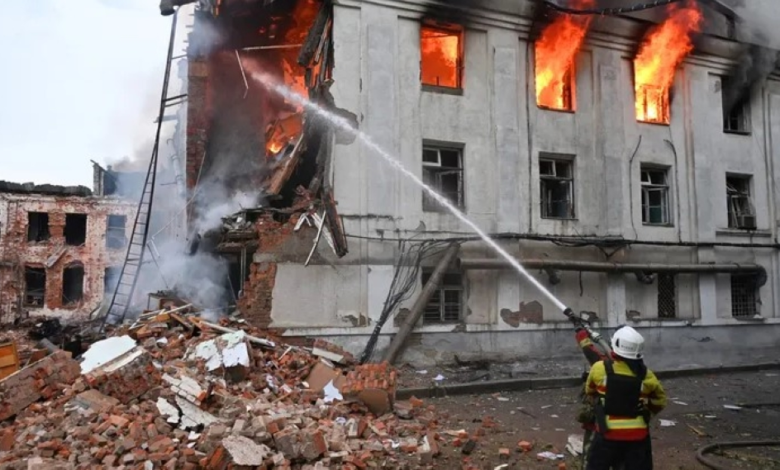

The Russian-Ukrainian war opened its new year with an unprecedented military escalation, as Ukrainian President Volodymyr Zelensky announced on Thursday that Russia had begun 2026 with a large-scale air attack, using more than 200 attack drones that primarily targeted the country's energy infrastructure, reflecting Moscow's determination to pursue a strategy of attrition against Kyiv's vital capabilities as the war enters its fifth year.
Targeting energy infrastructure
Zelenskyy stated in a social media post, "Russia started the year with war, targeting Ukraine with over 200 attack drones overnight," emphasizing that "the targets were our energy infrastructure." This attack is part of an ongoing Russian military tactic aimed at plunging Ukrainian cities into darkness and disrupting economic and social life, particularly given the drop in temperatures and increased demand for heating. This places immense pressure on Ukraine's air defense systems, which are attempting to intercept these drone swarms.
Mutual accusations and 24 killed in Kherson
Meanwhile, in another development reflecting the intensity of the clashes, Russia accused the Ukrainian army of launching a deadly attack on New Year's Eve. The Russian Investigative Committee stated in an official statement that Ukrainian shelling targeted a cafe in the village of Khorly, located in the Moscow-controlled part of the Kherson region, killing at least 24 people.
Vladimir Saldo, the governor of the region appointed by the Russian authorities, confirmed via Telegram that the attack was "intense" and resulted in dozens of injuries of varying severity, describing the incident as a dangerous escalation targeting civilians in areas under Russian control.
Background of the conflict and its regional repercussions
This dual escalation underscores the fact that the war, which erupted in February 2011, remains far from any prospect of a political solution. The Kherson region is one of four regions that Russia annexed earlier, a move still rejected by Kyiv and the international community. These regions regularly become battlegrounds for fierce fighting and exchanges of artillery and airstrikes.
Observers believe that Russia’s continued targeting of energy infrastructure, coupled with Ukraine’s intensification of qualitative strikes behind Russian lines, indicates that 2026 may witness tactical shifts in the management of the battle, with both sides increasingly relying on drone warfare as a low-cost and effective alternative to wear down the enemy, amid international concerns about the expansion of the conflict and the worsening of the humanitarian crisis.