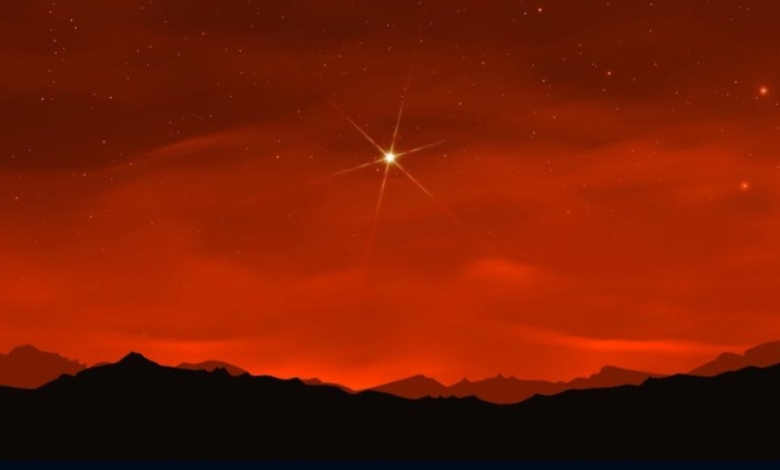

The Jeddah Astronomical Society has revealed a significant astronomical event occurring in the solar system: Mars will enter a state known as "solar conjunction" on January 9, 2025, causing it to disappear completely from view for several weeks. Engineer Majid Abu Zahra, head of the society, explained that this event represents a temporary turning point in observing the Red Planet, as it will appear to pass very close to the Sun's disk from our perspective on Earth.
Details of the solar conjunction phenomenon
According to official statements, this conjunction occurs when Mars is positioned on the opposite side of the Sun from Earth, making the central star (the Sun) an optical barrier between the two planets. At this time, the distance between Earth and Mars reaches its maximum, approximately 359 million kilometers. Because the angular separation between Mars and the Sun approaches zero degrees, the planet is completely immersed in the Sun's intense light, making it practically impossible to observe.
Impact of the phenomenon on international space missions
It is worth noting, in the context of expanding scientific understanding of the importance of this event, that the phenomenon of the Martian solar conjunction affects not only amateur astronomers and observers, but also global space agencies such as NASA and the European Space Agency. During the conjunction, radio signals transmitted to and from spacecraft on the surface of Mars or in its orbit are subjected to significant interference due to the hot plasma emitted from the sun's corona. Consequently, ground control centers typically cease sending complex commands to probes and rovers (such as the Perseverance rover) to avoid data loss or technical errors, and the spacecraft enter a "safe" mode until the phenomenon passes.
The return of the astronomical observation cycle
Abu Zahra pointed out that Mars, despite its current disappearance, will begin to gradually move away from the sun in the coming weeks, reappearing in the dawn sky low on the eastern horizon before sunrise. This phase is part of the planet's synodic cycle, during which its brightness and apparent size will slowly increase over the months, culminating in the phenomenon of "opposition" after about 26 months—the golden period when the planet is at its closest point to Earth and at its brightest.
Important health warnings
In closing his report, the head of the Jeddah Astronomical Society issued a very important warning to the general public and amateur astronomers: they must absolutely refrain from attempting to observe or search for Mars in the sky during this period using binoculars or telescopes. He emphasized that pointing any magnifying lens at the area near the sun poses a serious risk, as the sudden intrusion of sunlight into the field of vision can burn the retina and cause permanent blindness or irreversible visual damage.