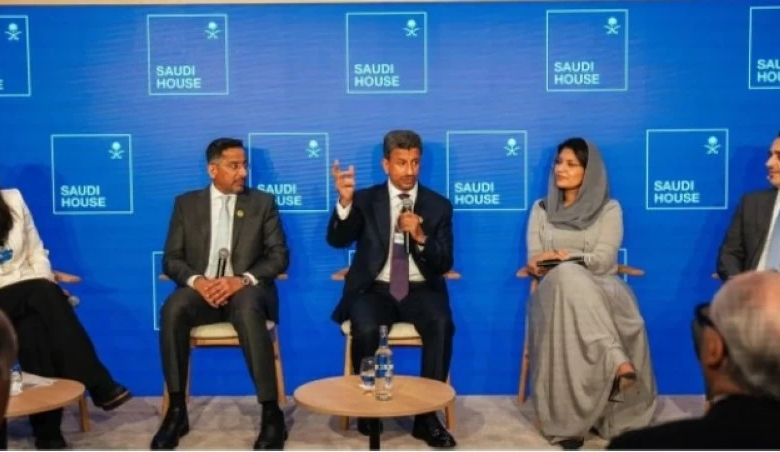

In a renewed affirmation of the Kingdom of Saudi Arabia’s strategic direction towards building a knowledge-based and innovation-driven economy, the Ambassador of the Custodian of the Two Holy Mosques to the United States of America, Princess Reema bint Bandar bin Sultan, stressed that the future of global economic competitiveness depends on giving the highest priority to investment in human capital.
This came during her participation in a panel discussion at the "Saudi House" pavilion during the World Economic Forum's 2026 Annual Meeting, where she explained that human capital is no longer merely a contributing factor, but rather the primary driver for building modern, resilient, and competitive economies. She pointed out that empowering individuals and placing talent in the right positions is the key to transforming latent potential into tangible achievements, emphasizing that the Kingdom now possesses the supportive environment and necessary resources to achieve this qualitative leap.
Tourism and investment: Record-breaking figures ahead of their time
In reviewing economic achievements, Minister of Tourism Ahmed Al-Khatib revealed significant leaps made by the travel and tourism sector, which has been a key pillar since the launch of the Kingdom's Vision 2030. Al-Khatib explained that the Kingdom not only achieved its target of receiving 100 million tourists annually by 2030, but also succeeded in reaching this number seven years ahead of schedule, with continued growth in tourist spending rates, reflecting the Kingdom's attractiveness as a global destination and the diversification of national income sources.
For his part, Minister of Investment Khalid Al-Falih highlighted the significant transformation in the investment environment, noting that foreign direct investment has increased fivefold compared to pre-Vision 2030 levels. Al-Falih emphasized that the Kingdom has successfully created a balanced environment that allows for seizing opportunities while managing risks efficiently, resulting in capital formation as a percentage of GDP comparable to that of major global economies.
Youth and the private sector: the fuel of national transformation
To reinforce this comprehensive picture, Minister of Industry and Mineral Resources Bandar Al-Khorayef emphasized that the Kingdom's true competitive advantage lies in its large youth population. He explained that young people represent the most important global resource in the modern era, and that a country's ability to maximize the added value of its natural resources depends entirely on investing in the potential of these young people.
Regarding financial sustainability and planning, Finance Minister Mohammed Al-Jadaan noted that a clear vision and ambition were the decisive factors in gaining the trust of the public and investors in the transformation process. Meanwhile, Minister of Economy and Planning Faisal Al-Ibrahim concluded by emphasizing the growing role of the private sector, which has become a leading partner in the current economic trajectory, pointing out that innovation, research, and development have become integral to the Kingdom's new economic identity.
The context of economic transformation and its global impact
These statements come at a time when Saudi Arabia is undergoing an unprecedented historical transformation, moving from total dependence on oil to diversifying its sources of income through promising sectors such as tourism, technology, and industry. The strong Saudi presence at the Davos Forum reflects the economic and political weight Riyadh now wields as a key player in shaping the future of the global economy, presenting a successful model of rapid and comprehensive economic reform that places human beings at the heart of the development process.