
Beneficial rains cover 9 Saudi regions
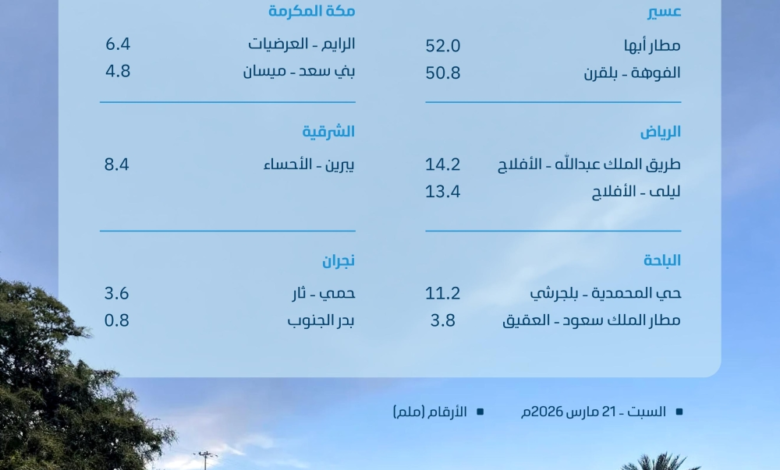
Over the past 24 hours, Saudi Arabia experienced widespread rainfall across nine different regions, bringing refreshing and promising weather. The Asir region recorded the highest rainfall amounts , according to official reports from relevant authorities, reflecting the unique climatic diversity of the Kingdom's regions.
Climate context and the role of monitoring bodies
Historically, Saudi Arabia has been a country with an arid desert climate. However, climate change and transitional seasons often bring with them periods of atmospheric instability that result in varying levels of rainfall. The Ministry of Environment, Water and Agriculture, in cooperation with the National Center for Meteorology, plays a vital role in monitoring these changes through a wide network of 63 hydrological and climatological monitoring stations strategically located throughout the country to ensure the provision of accurate and up-to-date data.
Asir leads the way with the highest rates
In detail, the daily report from the Ministry of Environment, Water and Agriculture revealed that the Asir region recorded the highest rainfall at 52.0 mm at Abha Airport. Other rainfall amounts in the region included 50.8 mm in Al-Fawhah in Balqarn, 40.2 mm in Al-Tamam in Abha, and 37.8 mm in both Tab in Abha and Al-Asran in Sarat Abidah. Al-Namas recorded 35.8 mm in Al-Ashra, and 31.6 mm in North Al-Bashair in Balqarn, while Al-Shaaf in Abha and the airbase in Khamis Mushait each recorded 20.6 mm.
Rainfall distribution in Riyadh and Al-Baha
In the Riyadh region, rainfall amounts reached 14.2 mm on King Abdullah Road in Al-Aflaj, 13.4 mm in Layla, 11.8 mm in Al-Aflaj, and 5.8 mm in As-Sulayyil. The Al-Baha region, renowned for its stunning natural beauty, recorded 11.2 mm in Al-Muhammadiyah neighborhood of Baljurashi, 3.8 mm at King Saud Airport in Al-Aqiq, 3.3 mm in Jarab, and 1.4 mm in Wadi Khaitan.
Rain in the Eastern Province, Mecca and other regions
The beneficial rainfall extended to the Eastern Province, which recorded 8.4 mm in Yabrin, Al-Ahsa. In the Makkah region, the amount reached 6.4 mm in Al-Raym, Al-Ardiyat, 4.8 mm in Bani Saad, Maysan, 3.0 mm in Khamis Harb, Al-Qunfudhah, and 1.3 mm in Al-Suwar, Taif. The report also included the Najran, Jazan, Northern Borders, and Tabuk regions with varying amounts, where Hama recorded 3.6 mm in Thar, Najran, 2.0 mm in Fifa, Jazan, 1.0 mm at Tarif Airport, Northern Borders, and 0.8 mm in Abu Al-Qazaz, Al-Wajh, Tabuk.
Environmental and tourism impact of rainfall
These rains are of paramount importance at both the local and regional levels. From an environmental and agricultural perspective, the rainfall contributes to replenishing groundwater reserves and irrigating farms and natural pastures, thus supporting the goals of Saudi Vision 2030 in achieving food security and the sustainability of water resources. Furthermore, the dams distributed throughout the Kingdom play a significant role in harvesting this water and utilizing it during dry seasons.
From a tourism perspective, this rainy weather plays a pivotal role in boosting domestic tourism, especially in southern regions like Asir and Al-Baha. The rain increases vegetation density and moderates temperatures, making these areas popular destinations for visitors from within the Kingdom and the Gulf countries. This, in turn, positively impacts the local economy and supports the accommodation and tourism services sectors.