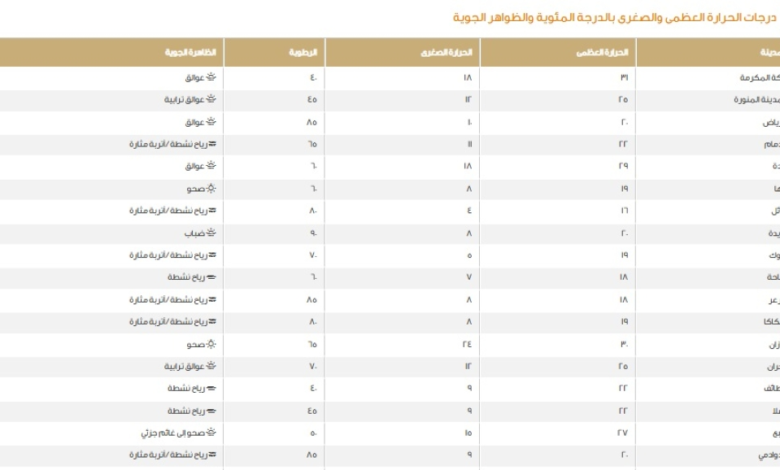

The National Center for Meteorology in Saudi Arabia revealed details of the maximum temperatures recorded on Wednesday across various regions and cities of the Kingdom. The data showed a noticeable variation in weather conditions between the coastal, central, northern, and southern highlands. Dammam recorded 22 degrees Celsius, while Mecca topped the list with 31 degrees Celsius.
List of maximum temperatures in the cities of the Kingdom
The National Center for Meteorology's report indicated that the maximum temperatures varied, reflecting the geographical diversity of the Kingdom. The detailed list is as follows:
- Mecca: 31 degrees Celsius.
- Jazan, Sharurah, Al Qunfudhah: 30 degrees Celsius.
- Jeddah: 29 degrees Celsius.
- Yanbu: 27 degrees Celsius.
- Bisha: 26 degrees Celsius.
- Medina, Najran, Wadi Al-Dawasir: 25 degrees Celsius.
- Face: 24 degrees Celsius.
- Dammam, Taif, Al-Ula, Al-Ahsa: 22 degrees Celsius.
- Riyadh, Buraidah, Dawadmi, Al-Kharj: 20 degrees Celsius.
- Abha, Tabuk, Sakaka, Rawdat Al Tanhat, Al Dahna Desert: 19 degrees Celsius.
- Al-Baha, Arar, Al-Majma’ah, Rafha, Al-Qurayyat, Hafr Al-Batin, Guarantee: 18 degrees Celsius.
- Hail: 16 degrees Celsius.
- Tarif: 15 degrees Celsius (the lowest recorded).
- Al-Sawda: 12 degrees Celsius.
Climatic and geographical diversity in the Kingdom
This daily report reflects the diverse geography of Saudi Arabia, a vast country whose expansive area results in multiple climatic patterns occurring simultaneously. While coastal areas such as Jeddah, Jazan, and Dammam experience relatively mild to warm temperatures due to the influence of water bodies and humidity, northern regions like Tarif and Hail record noticeably lower temperatures, a common occurrence at this time of year as these areas are affected by cold air masses from the north.
In contrast, the southwestern mountainous regions, such as Abha, Al-Baha, and As-Soudah, maintain a relatively mild and cool climate compared to other areas, making them attractive tourist destinations year-round. The central regions, such as Riyadh and Al-Qassim, are characterized by a continental desert climate with mild daytime temperatures and cool nights during the transitional and winter seasons.
The importance and impact of weather reports
The daily reports issued by the National Center of Meteorology are of paramount importance at both the local and regional levels. Locally, this data helps citizens and residents plan their daily activities and exercise caution while traveling on highways connecting cities, especially given the potential for weather fluctuations. This information is also vital for various economic sectors, such as agriculture, transportation, and logistics, which rely heavily on accurate weather forecasts to ensure the efficient and safe operation of their activities.
The National Center of Meteorology operates according to the latest international standards and uses advanced monitoring technologies to ensure the accuracy of the information provided, which enhances public safety and reduces the risks associated with various weather phenomena, whether it is a rise in temperatures, cold waves, or dust storms that may affect horizontal visibility.