Today's maximum temperatures in Saudi Arabia: Dammam 22°C, Al Qunfudhah 30°C

The National Center for Meteorology in Saudi Arabia announced on Tuesday details of the maximum temperatures recorded in various regions and cities of the Kingdom. The data revealed a clear climatic variation reflecting the diverse geographical nature of the country. The city of Dammam recorded 22 degrees Celsius, while temperatures varied between the northern, coastal, and central regions.
Details of maximum temperatures in the cities of the Kingdom
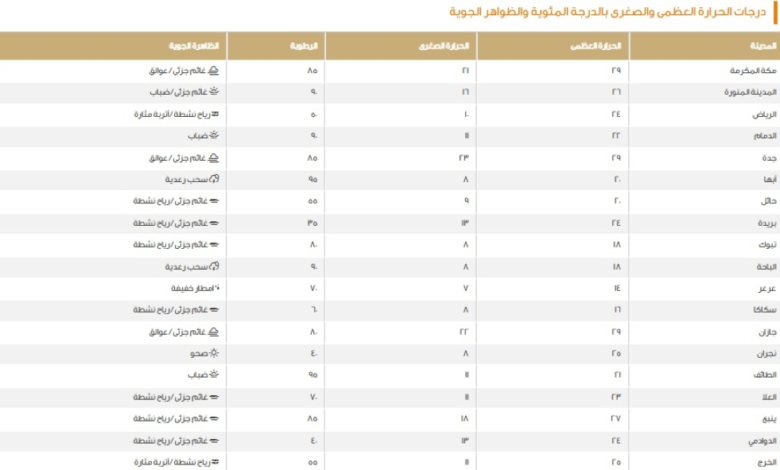
According to the report issued by the center, the maximum temperatures recorded today were as follows:
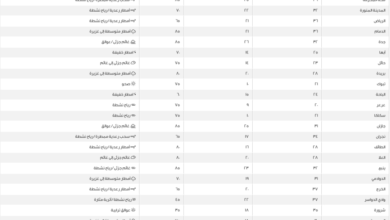
- Eastern and Central Region: Dammam recorded 22 degrees Celsius, while the capital Riyadh recorded 24 degrees Celsius, Al-Ahsa 25 degrees Celsius, Al-Majma’ah 24 degrees Celsius, and Al-Kharj 25 degrees Celsius.
- In the western and coastal regions, temperatures in Mecca, Jeddah, and Jazan reached 29 degrees Celsius, while Al-Qunfudhah recorded the highest temperature on the list at 30 degrees Celsius. Medina recorded 26 degrees Celsius, and Yanbu 27 degrees Celsius.
- Northern regions: witnessed a significant decrease, with Tarif recording the lowest maximum temperature at 11 degrees Celsius, Al Qurayyat at 13 degrees Celsius, Arar at 14 degrees Celsius, Sakaka at 16 degrees Celsius, and Tabuk at 18 degrees Celsius.
- Southern regions and highlands: Abha and Hail recorded 20 degrees Celsius, Al-Baha 18 degrees Celsius, Najran 25 degrees Celsius, and Al-Soudah 14 degrees Celsius.
- Other areas: Buraidah, Al-Dawadmi and Hafr Al-Batin 24 degrees Celsius, Taif 21 degrees Celsius, Al-Ula 23 degrees Celsius, Wadi Al-Dawasir 25 degrees Celsius, Sharurah 26 degrees Celsius, Al-Wajh 22 degrees Celsius, Rafha 18 degrees Celsius, Bisha 27 degrees Celsius.
The role of the National Center for Meteorology and the importance of weather monitoring
This report is part of the National Center for Meteorology's ongoing efforts to monitor weather phenomena and issue accurate forecasts. The Center is the official body authorized in the Kingdom to issue weather data, relying on a vast network of advanced monitoring stations and satellites to ensure the accuracy of its information. This data aims to enhance public safety, support vital sectors such as aviation, maritime navigation, and agriculture, and assist citizens and residents in planning their daily activities.
Climate diversity in the Kingdom of Saudi Arabia
The figures recorded today reveal the great diversity of the Kingdom's climate, influenced by its vast geographical area and varied topography. While northern regions such as Tarif and Qurayyat experience relatively cool weather due to their geographical location and exposure to air masses from the north, coastal areas like Jeddah, Qunfudhah, and Jazan enjoy warmer and more humid conditions due to the influence of the Red Sea. In contrast, the central and eastern regions maintain moderate temperatures for this time of year, reflecting the continental and desert climate that prevails across large parts of the country.
The importance of following weather forecasts
Monitoring temperatures and weather forecasts is particularly important given the weather fluctuations the region may experience. This information helps drivers on highways take precautions, especially in areas with reduced visibility or sudden changes in conditions. It also guides farmers in protecting their crops in areas prone to cold spells and supports the domestic tourism sector by directing visitors to areas with milder climates suitable for outdoor activities.