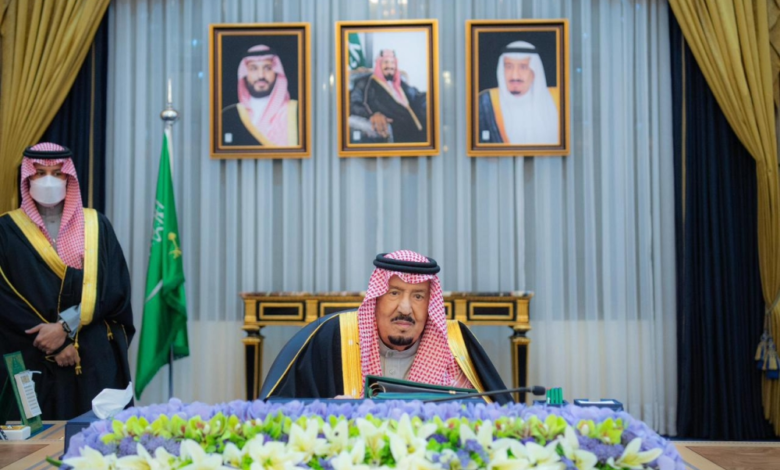

The Custodian of the Two Holy Mosques, King Salman bin Abdulaziz Al Saud, chaired the Cabinet session held today in Riyadh, which included a comprehensive review of the overall local, regional, and international situation. At the outset of the session, the King briefed the Cabinet on the contents of the written message he received from Russian President Vladimir Putin, which focused on ways to strengthen bilateral relations between the two friendly countries, reflecting the depth of the strategic partnership and the Kingdom's pivotal role in international affairs.
A firm stance regarding national security and the Yemeni issue
In reaffirming its steadfast policy, the Cabinet reiterated that the Kingdom will not hesitate to take all necessary measures to protect its national security from any threat. The Cabinet also discussed the situation in Yemen at length, emphasizing Riyadh's unwavering commitment to supporting Yemen's security, stability, and sovereignty, and its full support for the Yemeni Presidential Leadership Council and the legitimate government.
The Council discussed the field and political developments, expressing its regret that de-escalation efforts have been hampered by escalations that contradict the objectives of the Coalition to Support Legitimacy. The Council stressed the need to prioritize wisdom and the higher interests of Yemen and the Gulf states, calling for a response to Yemeni demands to end all illegitimate armed activity and to work towards unifying ranks to ensure regional stability. It also noted the important role the Coalition plays in protecting civilians in Hadramawt and Al-Mahra and preventing the conflict from spreading further.
Supporting Somalia's sovereignty and rejecting partition
On the African front, the Cabinet reaffirmed the Kingdom’s unwavering support for the sovereignty and territorial integrity of the Federal Republic of Somalia. The Cabinet expressed its categorical rejection of any unilateral actions aimed at undermining this unity, including the declaration of mutual recognition between the Israeli occupation authorities and the so-called “Somaliland” region, considering it a violation of international law and the UN Charter, and an attempt to destabilize the vital Horn of Africa region.
Local development and international partnerships
Domestically, the Council noted the Kingdom's rapid development efforts within the framework of "Saudi Vision 2030." It commended the commencement of the third phase of projects under the Riyadh Ring Road and Main Road Development Program, a strategic step aimed at enhancing the capital's position as a global logistics hub and improving the quality of life for its residents.
The Council also commended the outcomes of the Saudi-Omani Coordination Council, emphasizing the deep fraternal relations between the two countries and the tangible progress achieved in economic and investment matters. The Council concluded its session by issuing a series of decisions and approvals, including memoranda of understanding and cooperation agreements with several countries, including Pakistan, Iraq, Hungary, and Palestine, in the fields of energy, health, justice, and communications, thus strengthening the Kingdom's international presence and its diverse partnerships.