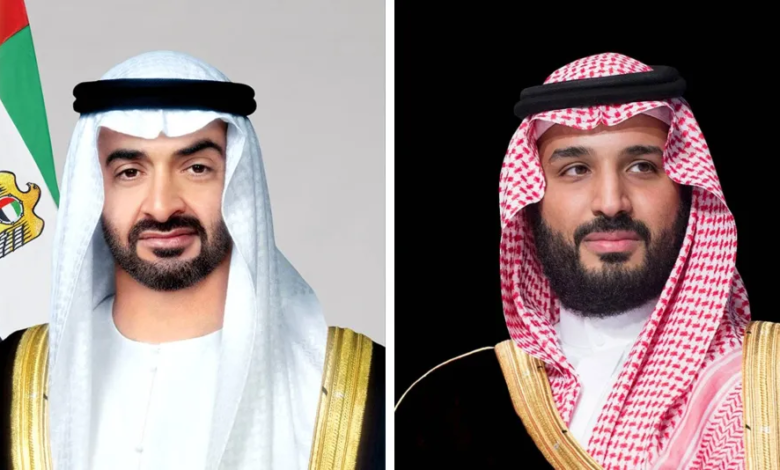
The Saudi Crown Prince and the President of the UAE discuss regional developments

Introduction to telephone communication and its strategic importance
In the context of ongoing coordination and continuous consultation between the leaderships of the two brotherly countries, His Royal Highness Prince Mohammed bin Salman bin Abdulaziz Al Saud, Crown Prince and Prime Minister of the Kingdom of Saudi Arabia, held a telephone conversation with his brother, His Highness Sheikh Mohammed bin Zayed Al Nahyan, President of the United Arab Emirates. The call addressed the strong fraternal bilateral relations between Riyadh and Abu Dhabi, as well as discussing the latest developments in the region and their repercussions on regional and international security and stability, reflecting the two leaderships' commitment to unifying their visions and positions on critical issues.
The historical context of Saudi-Emirati relations
The relationship between the Kingdom of Saudi Arabia and the United Arab Emirates is based on deep-rooted historical foundations, shared blood ties, religious faith, and a common destiny. This relationship has witnessed unprecedented strategic development in recent years, culminating in the establishment of the Saudi-Emirati Coordination Council. This council aims to strengthen the strategic partnership in the economic, political, military, and security fields, fulfilling the aspirations of the two brotherly nations. This close cooperation extends beyond bilateral interests, serving as a bulwark of security for the entire Arab region in the face of escalating challenges and foreign interference.
The importance of joint coordination in light of regional challenges
These telephone conversations between the Saudi Crown Prince and the UAE President come at a crucial time, as the Middle East region witnesses rapid transformations and complex security and political challenges. Joint coordination is a cornerstone for ensuring regional stability. Both countries play a pivotal role in leading diplomatic efforts to de-escalate tensions, whether related to crises in some Arab states or to maintaining the security of navigation in strategic waterways that are vital to the global economy and international trade.
The expected impact of Saudi-Emirati cooperation
At the local and regional levels
Domestically, this alignment positively impacts the development trajectory of both countries, as the goals of Saudi Arabia’s Vision 2030 converge with those of the UAE Centennial 2071 in their pursuit of economic diversification, fostering innovation, and empowering youth. Regionally, the unified stance of Riyadh and Abu Dhabi contributes to strengthening Gulf and Arab solidarity, providing a political and economic framework that supports development and peace efforts in neighboring countries, thereby mitigating conflicts and opening new horizons for joint regional cooperation that benefits all the peoples of the region.
On the international level
Internationally, Saudi-Emirati moves are attracting significant attention from the international community. The Kingdom and the UAE are among the world's leading economic powers and play a crucial role in stabilizing global energy markets. Furthermore, their membership in global economic blocs reflects their strategic weight. Therefore, any consultation between the two countries' leaderships regarding regional developments sends reassuring messages to global markets and underscores their commitment to supporting international peace and security through diplomatic solutions and constructive dialogue.
a summary
In conclusion, the phone call between the Saudi Crown Prince and the UAE President underscores the depth of the strategic alliance between the two countries. The continuation of this consultative approach strengthens the region's ability to confront current and future challenges and reaffirms that Riyadh and Abu Dhabi are the driving forces of stability and development in the Middle East, thus ensuring a more secure and prosperous future for the peoples of the region and the world at large.