The story of the Saudi flag: its symbolism of justice and security and its rich history

Introduction: The Saudi flag is a symbol of eternity and sovereignty
The Saudi flag embodies the story of a nation and the history of a people. It is not merely a banner waving in the skies of the Kingdom of Saudi Arabia, but a profound historical narrative that encapsulates the duality of justice and security. The Saudi flag reflects a deeply rooted national identity and stands as a testament to the journey of unification and nation-building led by the founder, King Abdulaziz bin Abdulrahman Al Saud, may God have mercy on him. To speak of the Saudi flag is to speak of the values and principles upon which the Saudi state has been founded, values that reflect strength, peace, and absolute justice.
Historical background and development of Saudi science
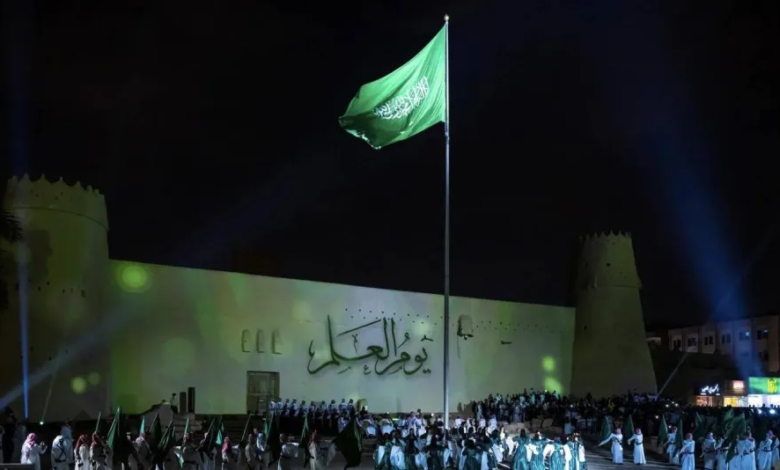
The Saudi flag traces its origins to the First Saudi State, founded in 1727 CE. The original banner was green, embroidered with silk and brocade, and bore the declaration of faith: “There is no god but God, Muhammad is the Messenger of God.” With the unification of the Kingdom of Saudi Arabia, the flag assumed its final form as we know it today. In a move reflecting deep appreciation for this national symbol, the Custodian of the Two Holy Mosques, King Salman bin Abdulaziz Al Saud, issued a royal decree designating March 11th of each year as Flag Day (Flag Day), the date on which King Abdulaziz approved the flag's design in 1937 CE.
The implications of science: the duality of justice and security
The narrative of the Saudi flag is embodied in its symbols and colors, which carry profound meanings:
- The two testimonies represent the message of peace and Islam, and affirm that the Kingdom is based on pure faith and monotheism, which is the foundation upon which legislation is built.
- The drawn sword symbolizes strength, firmness, and the upholding of justice. Here, the sword is not an instrument of aggression, but rather a symbol of justice, security, the protection of national achievements, and the defense of the oppressed.
- The color green: It reflects growth, prosperity, generosity, and tolerance, which are the values that characterize the Kingdom in its internal and external dealings.
The importance of science and its local, regional, and international impact
At the local level, the Saudi flag plays a pivotal role in strengthening national unity and deepening the sense of belonging and loyalty among the Saudi people. Celebrating the flag is a celebration of the Kingdom's journey of development and prosperity under Vision 2030, which aims to build a vibrant society, a thriving economy, and an ambitious nation.
Regionally and internationally, the Saudi flag holds an exceptional status. It is the only flag in the world that is never flown at half-mast, even in times of mourning or disaster, out of respect and reverence for the declaration of faith (shahada) inscribed upon it. This distinction bestows upon the flag international prestige and reflects the Kingdom's unwavering commitment to its religious and moral principles. Furthermore, the flag represents a nation of significant political and economic influence, playing a pivotal role in promoting peace and stability in the Middle East and the world, and actively participating in the G20, thus ensuring its presence at the most important international forums as a symbol of global justice and security.
conclusion
The narrative of the Saudi flag is an ongoing story of glory and greatness. Through the duality of justice and security, this flag continues to tell the tale of a nation that knows no limits, combining tradition and modernity, and striding confidently towards the future, carrying the banner of monotheism high in the sky of achievements.