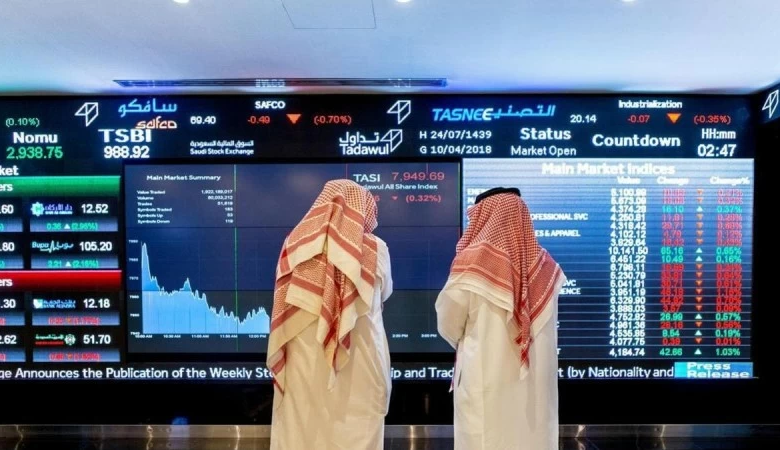

The Saudi stock market index (TASI) witnessed a remarkable and exceptional rise during today's trading, with screens awash in green, driven by strong buying momentum focused on leading stocks. The general index received significant and direct support from the shares of the global oil giant, Saudi Aramco, which recorded a substantial jump of 4.48%, continuing to benefit from positive data in global energy markets and improved oil prices, which positively impacted investor sentiment.
Performance of the general index and leading stocks
The main market index closed at 10,975.30 points, registering a 1.85% gain compared to the previous session's close. This rise is a strong indicator of the return of liquidity and positive trading activity to the market. In a related development, the positive performance was not limited to the main market; it extended to the parallel market index (Nomu), which recorded a slight increase of 0.17% to close at 22,534.17 points, indicating relative stability in the small and medium-sized enterprises (SMEs) sector.
Petro Rabigh takes center stage
In terms of company performance, Rabigh Refining and Petrochemical Company (Petro Rabigh) shares emerged as one of the session's standout performers, topping the list of the biggest gainers since the start of trading. The stock jumped to SAR 8.56, an increase of SAR 0.77, representing a growth of 9.88%, nearing the daily limit. This performance reflects optimism in the petrochemical sector, which is closely linked to energy price movements and global demand for refined products.
Economic importance and general context
This surge in the Saudi stock market is particularly significant given its position as the largest financial market in the Middle East and North Africa region. The movement of a leading stock like Aramco by this percentage not only impacts the overall index but also sends reassuring signals to local and international investors about the strength of the Saudi economy and the ability of its major companies to grow despite global economic challenges.
Historically, oil price movements have been the primary driver of the Saudi market, but with the Kingdom's Vision 2030, the market has begun to show greater maturity and diversification across its key sectors. Nevertheless, the energy sector remains the backbone that gives the market its strategic weight. This recovery is contributing to attracting more foreign capital inflows, especially since the Saudi market is included in global emerging market indices such as MSCI and FTSE, making any positive movement a focus of attention for portfolio managers worldwide.