Saudi Transport Minister discusses airspace management developments with Britain

Introduction to the strategic meeting
In a move reflecting the depth of bilateral relations and strategic cooperation between the Kingdom of Saudi Arabia and the United Kingdom, the Minister of Transport and Logistics and Chairman of the Board of Directors of the General Authority of Civil Aviation, Engineer Saleh bin Nasser Al-Jasser, reviewed the Kingdom's efforts and achievements in airspace management. This came during his reception of the UK's Secretary of State for Foreign, Commonwealth and Development Affairs, Yvette Cooper, and her accompanying delegation, at the Authority's headquarters in Riyadh, in the presence of the Authority's President, Mr. Abdulaziz bin Abdullah Al-Duailij.
General context and historical background of the event
This visit comes within the framework of the close historical relations between Riyadh and London, which extend over decades of joint cooperation in various fields, most notably the transport and aviation sector. These moves align with the objectives of Saudi Vision 2030 and the National Transport and Logistics Strategy, which aim to solidify the Kingdom's position as a global logistics hub connecting three continents (Asia, Africa, and Europe). The Saudi civil aviation sector has witnessed radical transformations in recent years, including the modernization of infrastructure and the adoption of the latest global technologies, making the Saudi experience a focus of attention for international partners.
Meeting details and operational management
During the meeting, several topics of mutual interest in the field of air transport were discussed. Both sides highlighted the Kingdom's significant efforts in managing its airspace and its highly efficient air traffic management mechanisms. The Kingdom relies on advanced technological systems operated by qualified national personnel, both men and women, who work according to the highest internationally recognized professional standards.
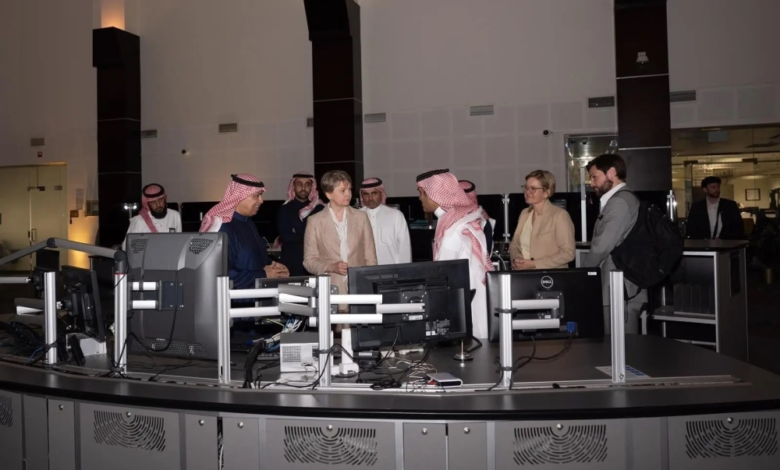
Following the official meeting, the President of the General Authority of Civil Aviation, the British Minister, and their accompanying delegation conducted a field visit to the Regional Control Center at King Khalid International Airport in Riyadh. During this tour, the British delegation was briefed on the air traffic monitoring mechanism and the 24/7 operational management processes. They were also introduced to the advanced technological systems used in airspace control, which directly contribute to enhancing safety and efficiency in air traffic flow.
The importance of the event and its expected impact
This meeting is of paramount importance on several levels. Locally, it highlights the competence of Saudi personnel and the capacity of the national infrastructure to accommodate and manage massive air traffic with the highest safety standards. Regionally, this collaboration reinforces Saudi Arabia's role as a safety valve and a key hub for air navigation in the Middle East, facilitating transit between East and West. Internationally, exchanging expertise with a leading nation like the United Kingdom contributes to harmonizing global standards, enhancing the efficiency of the global air transport sector, and ensuring the sustainability of supply chains and passenger traffic.
Review of Saudi air navigation capabilities
The visit included a comprehensive presentation by the Saudi Air Navigation Services Company (SANS). The presentation highlighted the company's pivotal role in managing air traffic within the Kingdom's airspace, emphasizing its integrated operational system designed to ensure the highest levels of safety and operational efficiency. The presentation went beyond routine operations, encompassing the company's proactive role in crisis management and response, employing advanced operational plans and established procedures to guarantee business continuity under all exceptional circumstances.
Prospects for future cooperation
At the conclusion of the visit, the Saudi and British sides discussed ways to enhance future cooperation, emphasizing the importance of exchanging experiences and knowledge in the fields of air navigation and airspace management, in order to serve common interests and support the development of the aviation industry at the international level.