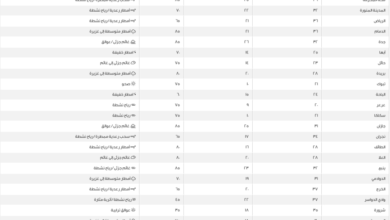

Various regions of Saudi Arabia experienced a significant drop in temperatures, with Rafha Governorate recording the lowest temperature of the day at -2 degrees Celsius, reflecting the peak of the cold wave affecting the northern regions. Similarly, Hafr Al-Batin and Arar recorded 0 degrees Celsius, while Sakaka and Hail recorded 1 degree Celsius, and Tarif recorded 2 degrees Celsius. This necessitates caution from residents and those traveling on highways.
Temperature details in major cities
The drop in temperature wasn't limited to the northern regions; the cold air mass also affected the central and eastern regions. The capital, Riyadh, along with Buraidah and Dawadmi, recorded a low of 4 degrees Celsius, while Al-Ahsa recorded 5 degrees Celsius. This temperature variation is typical of winter weather patterns in the Kingdom, where the northern and central regions are usually exposed to polar waves that lead to frost and sub-zero temperatures—a historically common weather pattern for this time of year, particularly during January and February.
Weather phenomena and the effect of wind
Regarding the expected weather conditions, the National Center for Meteorology explained that weather maps indicate active surface winds stirring up dust and sand, leading to reduced horizontal visibility. This will affect large parts of the Makkah, Madinah, and Tabuk regions, extending to the western parts of the Northern Borders, Al-Jawf, Hail, and Riyadh, reaching as far as parts of Najran and the Eastern Province. This weather pattern will be accompanied by partly cloudy to cloudy skies, with a chance of light rain in the northern parts of the Kingdom.
Sea conditions and navigation
Regarding maritime navigation, the Red Sea is experiencing surface winds ranging from 18 to 42 km/h, potentially reaching 55 km/h towards the Bab el-Mandeb Strait. This is causing waves to reach heights of up to 2.5 meters, resulting in rough sea conditions in the southern part. In the Arabian Gulf, northwesterly winds are active, reaching speeds of up to 52 km/h, with waves exceeding 2.5 meters in height. This results in moderate to rough sea conditions, necessitating a warning to fishermen and other seafarers in these areas.
These warnings are of particular importance due to their direct impact on movement and travel between cities, as experts always advise following official weather bulletins to avoid roads that experience heavy dust or lack of visibility, in addition to the need to take the necessary measures to protect against severe cold waves, especially for children and the elderly.