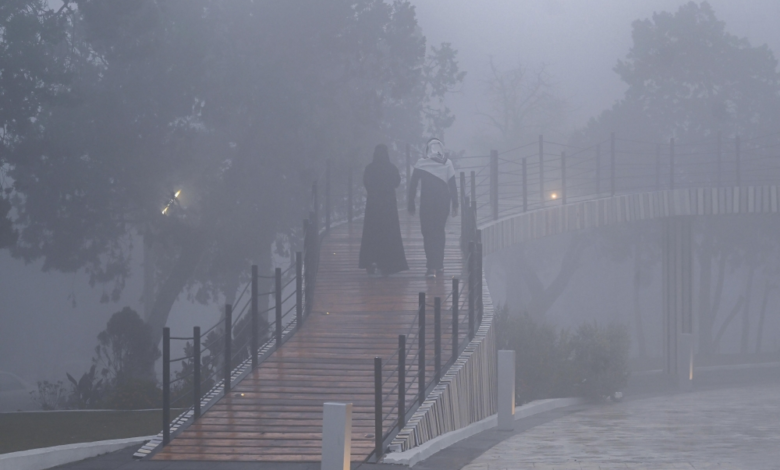

Saudi Arabia is expected to experience widespread atmospheric instability in the coming hours, with the National Center for Meteorology issuing a detailed report forecasting severe weather fluctuations affecting most regions of the Kingdom. These fluctuations will include thunderstorms of varying intensity, strong surface winds that will stir up dust and sand, and reduced horizontal visibility due to dense fog in the early morning hours.
Weather details and affected areas
According to data from the National Center for Meteorology, weather maps indicate significant surface wind activity that may stir up dust and sand, causing near-zero horizontal visibility, particularly in parts of the Tabuk, Al-Jawf, and Northern Borders regions. The situation is not limited to dust; there is also a chance of light rain in parts of these northern regions.
In a related development, thunderstorms accompanied by active winds are expected to extend across wide areas of the Kingdom, affecting parts of Jazan, Asir, Al-Baha, and Makkah, reaching as far as the capital, Riyadh, and the Eastern Province. The center also warned of fog formation that could impede traffic, particularly during the night and early morning hours, in parts of the aforementioned regions, as well as Hail, Qassim, and Madinah.
The climatic and geographical context of the Kingdom
These weather fluctuations are part of the climatic characteristics that distinguish the atmosphere of Saudi Arabia, given its vast geographical area and diverse topography, ranging from coastal and mountainous regions to deserts. The transitional periods between seasons are particularly active for low-pressure systems, which bring strong winds and rain. This climatic diversity makes it essential to follow weather forecasts closely, as weather conditions can vary drastically from one region to another at the same time, ranging from warm weather in the south to very cold weather in the north.
Weather conditions and safety recommendations
Given the nature of these fluctuations, they have a direct impact on daily life, particularly on highway traffic and maritime navigation. Such warnings are usually accompanied by calls from relevant authorities, such as civil defense and traffic police, urging caution, advising people to stay away from floodplains and valleys during rainfall, and emphasizing the need to use fog lights and reduce speed to avoid traffic accidents caused by reduced visibility.
Sea conditions and expected temperatures
Regarding maritime navigation, the Red Sea and the Arabian Gulf are experiencing significant turbulence. North to northwesterly winds are blowing across the northern and central parts of the Red Sea, while southeasterly winds are blowing across the southern part, with speeds reaching up to 50 km/h, resulting in waves exceeding two meters in height. In the Arabian Gulf, variable winds prevail, accompanied by moderate to rough seas.
Regarding temperatures, there is a significant variation, with the minimum reaching 4 degrees Celsius in Al-Soudah and 5 degrees in Sakaka, while Sharurah records the highest maximum temperature at 31 degrees Celsius, followed by Makkah and Jazan at 30 degrees Celsius.