Saudi Arabia weather: Tarif and Rafha at one degree, rain in Mecca and Al-Baha

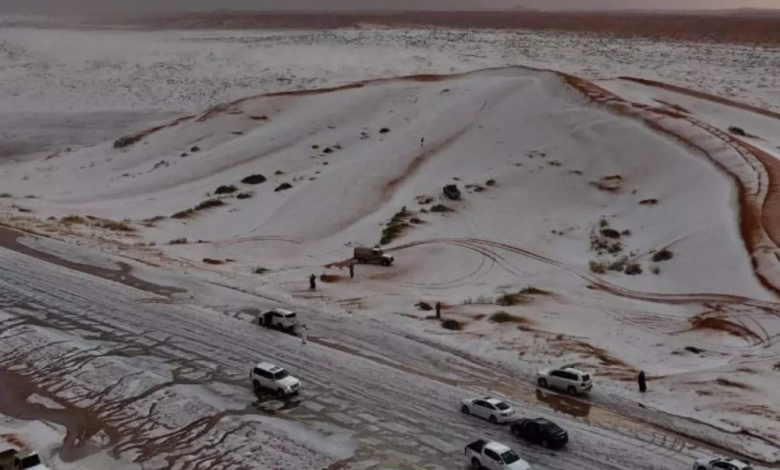
Northern regions of Saudi Arabia experienced a significant drop in temperatures as winter reached its peak. The governorates of Tarif and Rafha recorded the lowest temperatures in the Kingdom on Monday, January 5th, at just one degree Celsius. This decrease coincides with fluctuating weather conditions affecting several other regions, ranging from extreme cold to thunderstorms.
Details of recorded temperatures
According to data from the National Center for Meteorology, Tarif and Rafha were not the only areas on the list of the coldest; Arar and Hafr al-Batin recorded 2 degrees Celsius, while Qurayyat recorded 3 degrees Celsius. In the Al-Jawf region, the minimum temperature reached 4 degrees Celsius, while Hail, Khamis Mushait, and Abha all recorded 5 degrees Celsius, reflecting the widespread nature of the cold wave across the northern regions and the southern highlands.
Rain and strong wind forecast
The National Center for Meteorology explained that there is a chance of thunderstorms accompanied by active winds that will affect horizontal visibility in parts of the Al-Baha and Makkah regions today, God willing. This rainy weather will extend to the southern parts of the Madinah highlands. Meanwhile, cold to very cold weather will continue in parts of the Hail, Al-Jawf, and Northern Borders regions, with the cold air mass extending to the northern parts of the Eastern Province.
The center also warned of continued surface wind activity that stirs up dust and sand, which may limit horizontal visibility in parts of the Tabuk, Madinah, and Makkah regions, extending to the eastern parts of the southwestern highlands of the Kingdom.
The climatic and geographical context of the cold wave
The northern regions of the Kingdom, specifically Tarif, Arar, and Rafha, are the primary gateway for polar air masses originating from the northern hemisphere and Siberia during winter. These areas are characterized by their open desert landscape and high altitude, making them susceptible to temperatures that can reach or even drop below freezing at the peak of the season. This period is known locally as "Al-Murabba'aniyah" and "Al-Shabṭ," which typically sees the coldest days of the year.
State of the Red Sea and the Arabian Gulf
Regarding maritime conditions, the report indicated that surface winds over the Red Sea will be northeasterly to northwesterly in the northern and central parts, and southeasterly to southerly in the southern part, with speeds reaching up to 50 km/h, accompanied by thunderstorms. Rough seas are expected in areas affected by thunderstorms, necessitating caution for seafarers and fishermen.
In the Arabian Gulf, the winds will be northwesterly to northeasterly at a speed of up to 40 km/h, with wave heights ranging from one to two meters, and the sea state will be light to moderate.
Public safety recommendations
Due to these weather fluctuations, citizens and residents in the northern regions are advised to take necessary precautions against catching colds and to use safe heating methods. Those traveling on highways in areas experiencing dust storms or rain should also exercise caution and avoid floodplains and valleys in the Makkah, Al-Baha, and Asir regions, in accordance with Civil Defense instructions to ensure everyone's safety.