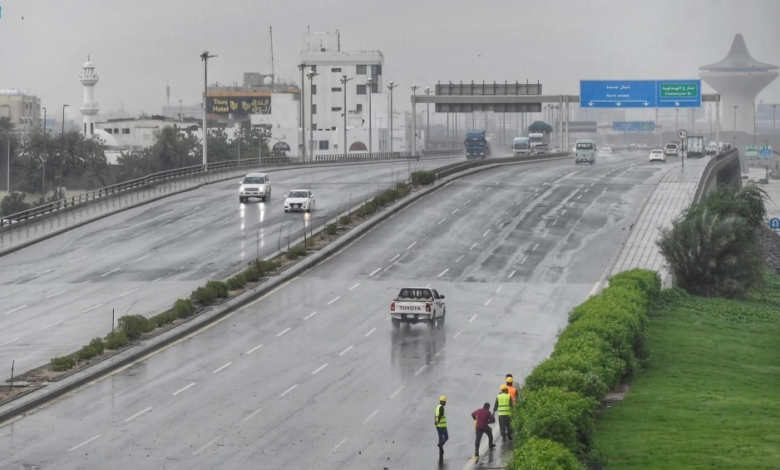

Weather alert: Red alert and heavy rain
The National Center for Meteorology in Saudi Arabia issued a high-risk warning, classified as a "red alert," forecasting moderate to heavy rainfall across large parts of seven administrative regions on Wednesday. These warnings are part of the ongoing monitoring of weather conditions and fluctuations to ensure the safety of citizens and residents.
Details of the weather conditions and associated effects
The weather report indicated that the rain would begin at 8:00 AM in some areas, while in others it would start at 9:00 AM. These weather fluctuations are expected to continue until 8:00 PM or 11:00 PM, depending on the specific region. This rainfall will be accompanied by a number of severe weather phenomena, most notably high winds leading to near-zero horizontal visibility, as well as hail, flash floods in valleys and ravines, a significant rise in waves along the coasts, and intense thunderstorms.
Areas covered by the red alert
The rainfall map includes the following regions and cities:
- Makkah Region: Adham, Maysan, Al-Khurmah, Al-Muwayh, Turbah, and Ranyah.
- Madinah region: Al-Ula, Khaybar, Al-Ais, Al-Rais, Yanbu, Madinah, Badr, and Wadi Al-Fara.
- Tabuk region: Tayma, Tabuk, Al Wajh, Umluj, Al Bada, Haql, Duba, and Neom Sharma.
- Al-Baha region: Al-Hajrah, Al-Makhwah, Far’ah Ghamid Al-Zanad, Qalwah, Al-Baha, Al-Aqiq, Al-Mandaq, Al-Qura, Baljurashi, and Bani Hassan.
- Hail region: Al-Shanan, Baqaa, Samira, Al-Hait, Al-Sulaimi, Al-Shamli, Al-Ghazala, Hail, and Muwaqq.
- Asir region: Al Namas, Balqarn, Tanomah, Al Harjah, Al Rabua, Al Farsha, Sarat Abidah, Dhahran Al Janoub, Abha, Ahad Rafidah, and Khamis Mushait.
- Jazan region: Al-Harth, Al-Dayer, Al-Raith, Al-Ardah, Al-Aydabi, Fifa, and Haroub.
General context and climate changes in the Kingdom
Historically, the Arabian Peninsula has been characterized by an arid desert climate, but transitional periods between seasons often witness periods of atmospheric instability. In recent years, Saudi Arabia has experienced a noticeable shift in weather patterns, with increased frequency and intensity of heavy rainfall and flash floods in areas unaccustomed to such amounts. Climate and meteorology experts attribute this shift to global climate change, which has impacted the region. This change has prompted relevant authorities, primarily the National Center for Meteorology, to develop early warning systems, such as the "Red Alert" system, as a crucial proactive tool for crisis management and minimizing losses.
The importance of the event and its expected impact
Locally, these rains are of paramount importance. On the one hand, they are a source of bounty and blessing, contributing to the replenishment of groundwater reserves and supporting the agricultural sector, particularly in the southwestern highlands such as Asir, Al-Baha, and Jazan, which rely heavily on rainfall. On the other hand, the resulting flash floods pose significant challenges to infrastructure, necessitating the mobilization of municipal and traffic authorities to facilitate traffic flow and prevent property damage. Regionally, this weather pattern reflects an extension of the low-pressure systems that have been affecting the Arabian Gulf region as a whole, underscoring the importance of regional cooperation in sharing climate data.
Civil Defense Public Safety Guidelines
In light of these conditions, the General Directorate of Civil Defense stressed the need for extreme caution. It urged citizens and residents to fully adhere to safety guidelines and avoid going out except when absolutely necessary during peak rainfall periods. It also strongly warned against approaching areas where water accumulates, including valleys, flood channels, and dams, due to the significant risk they pose to life. The relevant authorities emphasized the importance of following continuous weather updates through the official channels of the National Center of Meteorology to ensure public safety and navigate these weather fluctuations safely.