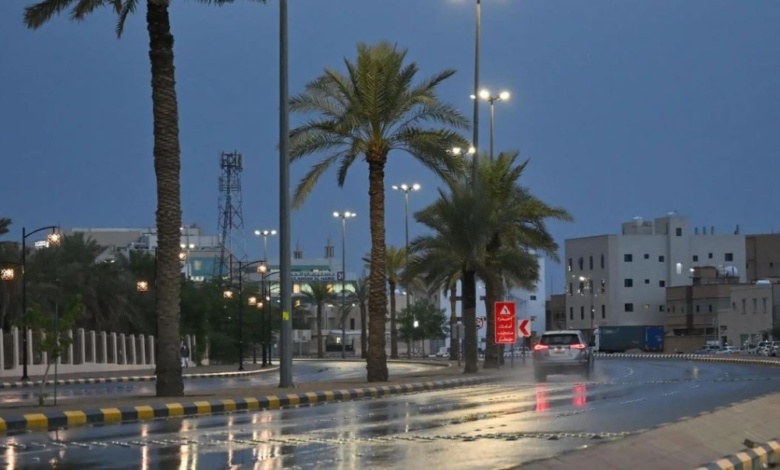

The National Center for Meteorology in Saudi Arabia has declared heavy rainfall accompanied by severe weather phenomena requiring caution in eight major administrative regions, as part of its ongoing monitoring of the evolving weather situation.
The detailed weather report indicated that this weather condition is not limited to rainfall only, but is accompanied by a package of influential phenomena that may pose a danger to lives and property, including strong surface wind that may lead to a lack of horizontal visibility, heavy hail, with a high probability of flash floods in valleys and ravines, high sea waves in coastal areas, as well as strong thunderstorms.
Map of regions and cities affected by the rainy weather
The warnings covered a wide geographical area including the coasts, highlands and central regions, and the distribution of affected cities was as follows:
- Eastern Province: Includes Jubail, Khobar, Dammam, Dhahran, Qatif, Ras Tanura, Hafr Al-Batin, Khafji, Nairyah, Qaryat Al-Ulya, Al-Ahsa, Al-Udayd, and Abqaiq.
- Riyadh Region: Riyadh (the capital), Al-Rayn, Al-Quway'iyah, Al-Hariq, Al-Kharj, Al-Dilam, Al-Muzahmiyah, Hawtat Bani Tamim, Thadiq, Huraymila, Rumah, Dhurma, Marat, and Al-Diriyah.
- Makkah Region: Taif, Al-Ardiyat, and Al-Qunfudhah.
- Jazan region: Farasan, Al-Harth, Al-Dayer, Al-Raith, Al-Ardah, Al-Aydabi, Fifa, Haroub, Abu Arish, Ahad Al-Masarihah, Al-Tuwal, Al-Fatihah, Samtah, Sabya, Damad, Al-Darb, and Bish.
- Asir region: Al-Barak, Al-Qahmah, Rijal Alma, Mahayil, Abha, Ahad Rafidah, Khamis Mushait, Al-Harjah, Al-Rabou'ah, Al-Farshah, Sarat Abidah, Dhahran Al-Janoub, Al-Majardah, Bariq, Al-Namas, Balqarn, and Tanomah.
- Al-Baha region: Al-Hajrah, Al-Makhwah, Far’ah Ghamid Al-Zanad, Qalwah, Al-Baha city, Al-Aqiq, Al-Qura, Al-Mandaq, Baljurashi, and Bani Hassan.
- Al-Qassim region: Al-Asyah, Al-Badai’, Al-Bukayriyah, Al-Thamiriya, Al-Shamasiya, Al-Ammar, Al-Mudhnib, Buraydah, Unayzah, Uyun Al-Jawa, Abanat, Al-Khabra, Ar-Rass, Al-Fawarah, An-Nabhaniah, Riyadh Al-Khabra, Dhariyah, and Uqlat As-Suqur.
- Hail region: Al-Shanan, Baqaa, Samira, Al-Hait, Al-Sulaimi, Al-Shamli, Al-Ghazala, Hail city, and Muwaqq.
What does “red alert” mean?
Activating the red alert a direct message from the relevant authorities indicating that the expected or current weather conditions are "severe" and extremely dangerous. This level of alert requires immediate action to ensure safety and to stay away from hazardous areas. This system is part of the Kingdom's advanced strategy for managing crises and natural disasters. The National Center for Meteorology relies on advanced monitoring technologies and satellites to track the movement of cumulonimbus clouds and predict their paths with high accuracy, thus contributing to minimizing human and material losses.
The climatic context and nature of the Saudi terrain
These warnings are doubly important given the diverse topography of Saudi Arabia. The areas covered by the warnings range from low-lying coastal regions and rugged mountainous areas like Asir and Al-Baha, to open desert regions like Riyadh and the Eastern Province. This diversity means different types of hazards; while mountainous areas face the risk of landslides and flash floods, major cities face the risk of water accumulation that could disrupt traffic, and open areas face the risk of downdrafts and dust storms.
These fluctuations usually occur during the transitional periods of the seasons, when thermal and cumulonimbus low-pressure systems become active, leading to strong and rapidly impacting atmospheric instability, which is known locally and regionally as the severity of weather phenomena in the Arabian Peninsula during the rainy seasons.
Civil Defense and Public Safety Guidelines
In conjunction with the weather report, the General Directorate of Civil Defense the importance of strictly adhering to the instructions announced through official media outlets and social media platforms. It urged citizens and residents to remain in safe locations during rainfall, to stay away from valleys, flood channels, and dams, and not to risk crossing them, no matter how low the water level may seem, as flash floods can suddenly and unexpectedly sweep through.
The relevant authorities also warned of the danger of using mobile phones in open areas during thunderstorms to avoid lightning strikes, and the need to secure objects that could be blown away in case of strong winds, stressing the readiness of emergency teams to deal with any reports resulting from the current rainy conditions.