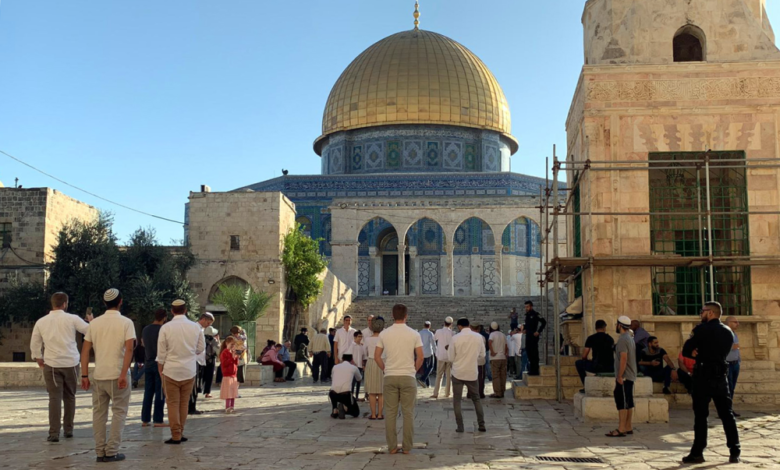
Settlers storm Al-Aqsa Mosque under the protection of the occupation police

of the Al-Aqsa Mosque in occupied Jerusalem today
Informed Jerusalemite sources and the Islamic Waqf Department reported that successive groups of settlers stormed Al-Aqsa Mosque in the morning from the direction of the Mughrabi Gate, which has been under full Israeli control since 1967. These groups carried out provocative tours in the mosque's courtyards, received explanations about the alleged "Temple," while some of them performed Talmudic rituals in the eastern area of the mosque, under heavy security protection from Israeli special forces who accompanied them until they exited through the Chain Gate.
Attempts to impose temporal and spatial division
These incursions are part of a systematic strategy pursued by settler groups with government support, aimed at imposing a new reality at Al-Aqsa Mosque known as "temporal and spatial division." Through this policy, the occupation seeks to allocate specific times for Jews to enter the mosque (temporal division) and to seize parts of its courtyards for their rituals (spatial division). This is categorically rejected by Palestinians and the Islamic Waqf, who consider it a blatant violation of the sanctity of the holy site.
Historical context and status quo
Historically, Al-Aqsa Mosque has been under the Hashemite custodianship of Jordan, and its administration is managed by the Islamic Waqf Department in Jerusalem. According to the historical and legal status quo, Al-Aqsa Mosque, encompassing 144 dunams (approximately 24 acres), including prayer halls, courtyards, domes, and both above and below ground, is a place of worship exclusively for Muslims. However, for years, the occupying authorities have been working to alter this reality by allowing settlers to storm the mosque compound, imposing severe restrictions on the entry of Muslim worshippers, particularly young people, and confiscating their identity cards at the gates.
Religious and political significance
Al-Aqsa Mosque holds immense religious significance as the first Qibla (direction of prayer) and the third holiest site in Islam, and the site of the Prophet Muhammad's Night Journey (Isra and Mi'raj). Therefore, any infringement upon it is considered a red line for Palestinians and the Muslim world. The ongoing incursions and attacks on worshippers have previously sparked numerous popular uprisings and military confrontations, making the continuation of these practices a major factor in fueling the conflict and destabilizing the entire region.
Jerusalemite bodies and religious authorities continue to call for people to travel to the Al-Aqsa Mosque and stay there, to confront the Judaization plans and to affirm the pure Arab Islamic right to the holy city and its holy sites.