12 observatories will be searching for the crescent moon of Shawwal in Saudi Arabia, starting from Dammam

Millions of Muslims in Saudi Arabia and across the Islamic world are turning their eyes to the heavens, awaiting the sighting of the crescent moon of Shawwal , which will determine the date of Eid al-Fitr and the end of the holy month of Ramadan. In this context, official and astronomical authorities have announced the preparation of 12 astronomical observatories strategically located throughout the Kingdom to carry out this precise religious and scientific task. The observation will begin in the city of Dammam in the Eastern Province at 5:50 PM, as it is one of the first cities in the Kingdom to experience sunset.
Details of the monitoring process and distribution of observatories
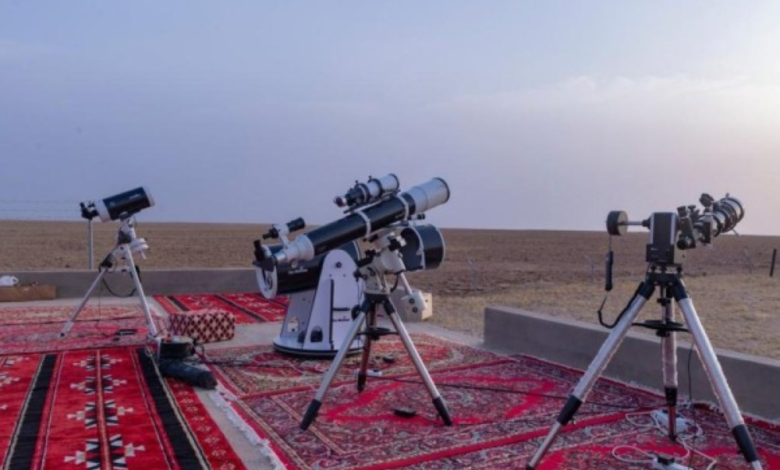
The Kingdom of Saudi Arabia relies on official moon-sighting committees and state-of-the-art astronomical observatories for observing the new moon. These 12 observatories are distributed across several regions, including Hawtat Sudair, Tamir, Shaqra, Mecca, Medina, Dammam, and other locations characterized by clear skies and freedom from light pollution. The actual observation process begins shortly before sunset, with experts and observers pointing telescopes towards the western horizon to search for the new crescent. These efforts are in response to the call of the Supreme Court of Saudi Arabia, which urges all Muslims to observe the new moon and report any sightings, whether with the naked eye or using binoculars, to the nearest court.
The religious and social significance of sighting the crescent moon of Shawwal
The sighting of the crescent moon of Shawwal holds immense importance in Islamic law, as it is a practical application of the Prophet's Sunnah, which links the beginning and end of lunar months to visual observation. The confirmed sighting of the crescent moon officially marks the end of Ramadan and the beginning of Eid al-Fitr, directly impacting the lives of citizens and residents through the commencement of official holidays, the launch of celebratory events, and the exchange of greetings and family visits. These moments possess a unique spiritual and social character, uniting members of the community in joy and celebration.
Historical and technological development in crescent moon observation
Historically, the sighting of the crescent moon was determined entirely by naked-eye observation from mountaintops and high-altitude areas. With scientific advancements, the relevant authorities have been keen to integrate modern technology with the traditional method of sighting the crescent. Today, the 12 observatories utilize advanced telescopes and astronomical cameras capable of capturing precise images of the crescent even in challenging weather conditions. This development has contributed to reducing errors and providing accurate astronomical data that supports the Supreme Court's decisions, while preserving the fundamental principle of direct sighting.
Regional and international impact of the Saudi announcement
The announcement of the sighting of the crescent moon of Shawwal has an impact not only within Saudi Arabia but also regionally and internationally. As the custodian of the Two Holy Mosques and the Qibla (direction of prayer) for Muslims, many Arab and Islamic countries, as well as Muslim minorities in Western countries, await the official Saudi announcement to determine the date of Eid al-Fitr. This connection reflects the Kingdom's significant religious standing and contributes to uniting the feelings of joy and celebration among millions of Muslims worldwide on a single day.