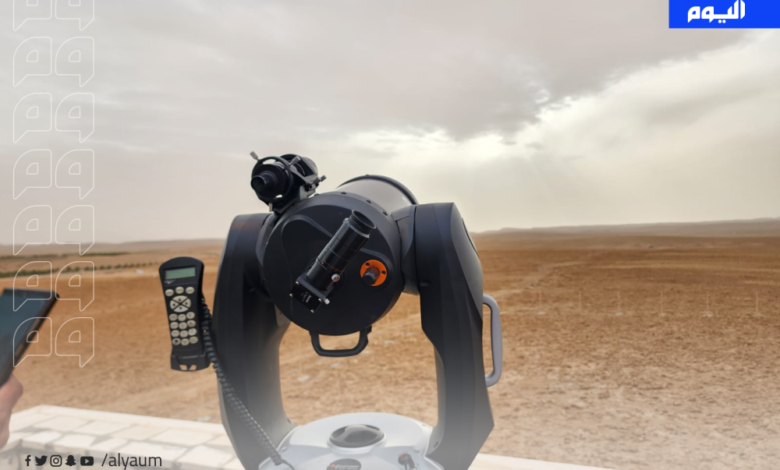
Sighting of the crescent moon of Shawwal 1447: Friday is the first day of Eid al-Fitr astronomically

Muslims eagerly await the date of Eid al-Fitr
On Wednesday evening, the 29th of Ramadan 1447 AH, Muslims in Saudi Arabia and across the Islamic world will be watching for the crescent moon of Shawwal, marking the end of the month of fasting and the beginning of Eid al-Fitr celebrations. This moment is of great importance, as moon-sighting committees and astronomical observatories throughout the Kingdom prepare to observe the new moon, in response to the call of the Supreme Court, which has consistently upheld this noble Sunnah.
The historical and legal context of sighting the crescent moon
Historically, the determination of the beginning of lunar months in Islamic law relied on direct visual sighting, in accordance with the Prophetic tradition concerning fasting and breaking the fast upon sighting the new moon. With scientific advancements, Saudi Arabia now combines the legitimate sighting with the naked eye or binoculars with precise astronomical calculations that support the observers and guide them towards the correct horizon. This harmony between Islamic law and astronomy serves as a model that enhances the accuracy of determining religious seasons, which affect millions of Muslims locally, regionally, and internationally, as they are linked to travel plans, official holidays, and economic market activity.
Umm al-Qura calendar and expert predictions
The observer Mutaib Al-Barghash explained that the process of sighting the new moon depends, after God's grace, on the observer's experience in determining the crescent's location on the western horizon after sunset, in addition to clear skies free from atmospheric obstructions such as dust and clouds. In a related context, the astronomical consultant at Al-Majmaah University, observer Abdullah Al-Khudairi, stated that the crescent of Shawwal will be visible, God willing, on the evening of Friday, the 1st of Shawwal 1447 AH (March 20, 2026 CE), according to the Umm Al-Qura calendar. He indicated that the crescent will remain visible for approximately 93 minutes after sunset and will be high and clearly visible in the sky, even from within cities, due to its age of about 38 hours and its altitude of approximately 20 degrees above the horizon.
The impossibility of sighting the crescent moon on Wednesday, astronomically speaking
For their part, astronomer Dr. Khalid Al-Zaaq and former professor of climatology at Qassim University, Professor Dr. Abdullah Al-Musnad, confirmed that astronomical data clearly indicates the impossibility of sighting the crescent moon of Shawwal on Wednesday evening, the 29th of Ramadan (March 18). Al-Musnad explained that the moon will set approximately 30 minutes before sunset in all regions of the Kingdom, and that the conjunction (the birth of the new crescent) will occur at dawn on Thursday at 4:26 AM. Based on this, it is astronomically expected that Ramadan will complete thirty days, making Friday, March 20, 2026, the first day of Shawwal and the first day of Eid al-Fitr.
Differences in moonrise times and their regional and international impact
Regionally and internationally, astronomer Mulham Hindi explained the reasons for the potential difference in the date of Eid al-Fitr among Islamic countries. He pointed out that countries that began fasting on Wednesday (such as Saudi Arabia and most Arab countries) will attempt to sight the crescent moon on Wednesday, March 18, but it will not be visible, making Thursday the 30th day of Ramadan. Countries that began fasting on Thursday (such as Oman, Egypt, Jordan, and Morocco) will attempt to sight the crescent moon on the evening of Thursday, March 19. On that day, the crescent moon will be visible with telescopes in the Arab world and with the naked eye in other regions, meaning that most Arab and Islamic countries will ultimately agree that Friday is the first day of Eid. However, Eid may be delayed until Saturday in some East Asian countries that rely solely on naked-eye observation.
The final word rests with the Supreme Court
Despite all these precise astronomical calculations, agreed upon by experts, including weather and climate researcher Abdulaziz Al-Hussaini, who predicted Ramadan would last 30 days, the final word and decision rests with the Supreme Court of Saudi Arabia. It is the official body authorized to receive testimonies from reliable moon-sighters in various regions and issue the official statement confirming or denying the sighting of the crescent moon, in accordance with the sound legal principles followed by the country.