Technologies at the Two Holy Mosques: Smart cooling and lighting to serve visitors

The General Authority for the Care of the Two Holy Mosques continues its tireless efforts to utilize the latest global technologies and smart systems to provide a safe and comfortable worship environment for pilgrims. These efforts are part of the Kingdom's ongoing commitment to enhancing the services offered at the Two Holy Mosques, keeping pace with the steady increase in the number of Umrah pilgrims and visitors, and fulfilling the objectives of the Kingdom's Vision 2030 in serving the guests of God.
Historical development and a qualitative technological leap
The services provided at the Two Holy Mosques have undergone significant transformations throughout history. From relying on simple, traditional methods for cooling and lighting, they are now managed through miniature smart cities. The process is no longer limited to providing cool air or light; it has evolved into an integrated technological system that ensures air purity and energy efficiency. This reflects the wise leadership's commitment to providing the utmost comfort for pilgrims, enabling them to perform their rituals with ease and tranquility.
The world's largest cooling systems
At the Grand Mosque, the General Presidency for the Affairs of the Two Holy Mosques operates one of the world's largest cooling systems, with a total cooling capacity of 155,000 tons. This capacity is distributed across two massive main stations: the Al-Shamiyah station with a capacity of 120,000 tons, and the Ajyad station with a capacity of 35,000 tons. The system uses a technology that cools water to very low temperatures, between 4 and 5 degrees Celsius, which is then pumped through a complex network of pipes to air handling units inside the mosque. This ensures a stable internal temperature between 22 and 24 degrees Celsius, the ideal temperature range for thermal comfort.
To ensure precise performance, (77) thermal sensors have been distributed throughout the Grand Mosque, reading climatic changes and crowd density, allowing the systems to automatically adjust the cooling. The system also features advanced air purification technologies with an efficiency of up to (95%), protecting visitors from dust and pollutants.
At the Prophet's Mosque, modern engineering is evident in the central cooling station, located 7 kilometers away. Spanning 70,000 square meters, it is one of the largest in the world. The station comprises six giant cooling units, each with a capacity of 3,400 tons, and distributes cool air through a network covering 2,357 columns within the mosque, ensuring smooth air distribution throughout all arcades and extensions.
Smooth movement and smart mobility
To address the challenges of managing millions of visitors, the Two Holy Mosques are equipped with a massive mechanical transportation network. The Grand Mosque (Masjid al-Haram) serves over 200,000 worshippers per hour via 220 escalators and 29 elevators strategically located to connect levels and facilitate the flow of pilgrims. In contrast, the Prophet's Mosque (Masjid an-Nabawi) has 180 escalators and 25 elevators, all of which undergo rigorous preventative maintenance programs to ensure their continuous operation according to the highest international safety standards.
Smart lighting that evokes spirituality
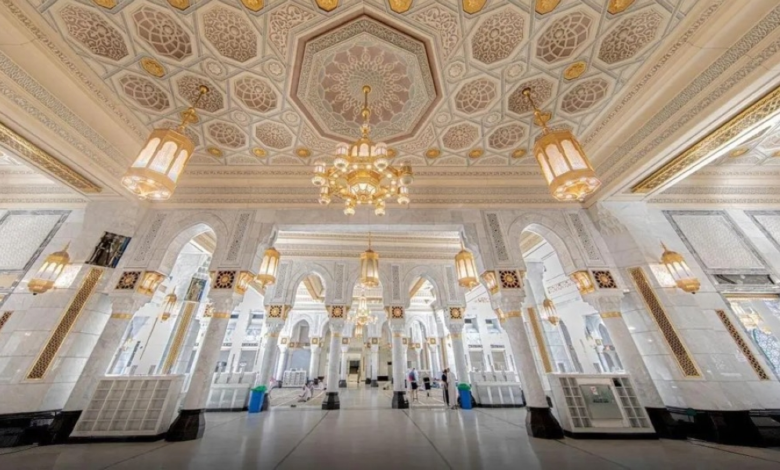
In terms of lighting, the Two Holy Mosques have transitioned from the era of traditional lanterns to the era of energy-efficient and environmentally friendly LED technology. The Grand Mosque in Mecca boasts over 120,000 lighting units and 6,900 luxurious chandeliers, while the Prophet's Mosque in Medina has over 137,000 uniformly colored lighting units.
This lighting system is managed through a smart building management system (BMS), which controls the intensity and timing of the lighting based on prayer times and human density, providing comfortable lighting that prevents glare and increases the worshippers' focus, while preserving the unique Islamic architectural character.
Asset management and sustainability
These services are complemented by an intelligent management and maintenance system that uses real-time data to predict malfunctions before they occur. Central control rooms monitor all systems to ensure their sustainability and optimize energy and water consumption, making the Two Holy Mosques a global model for managing large facilities with high efficiency and professionalism.